
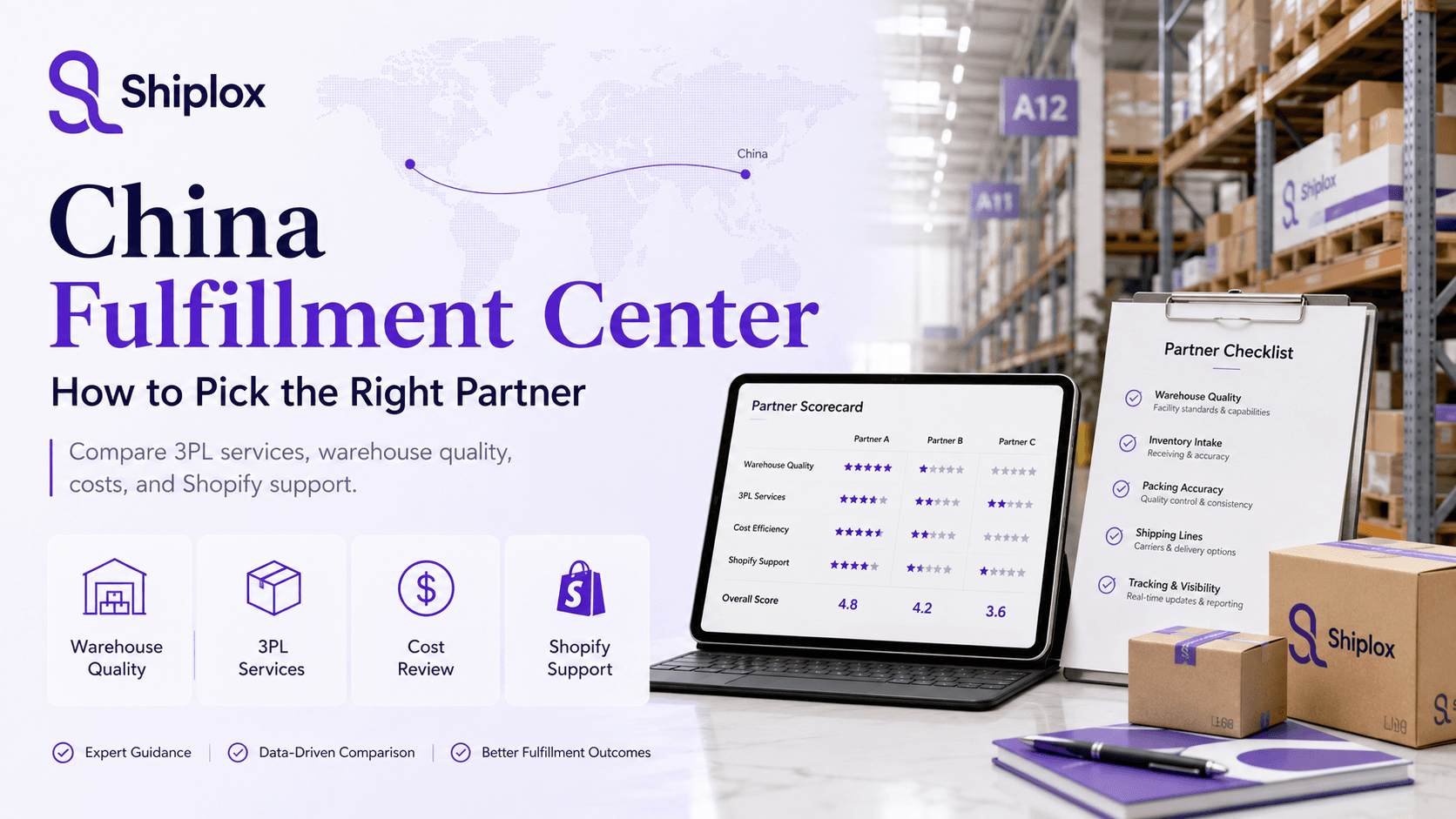
China warehouse fulfillment means storing inventory near your supplier base in China, quality-checking it before orders leave, and shipping individual customer parcels worldwide with tracking — instead of waiting for supplier handoffs or importing large batches to a local warehouse first. For Shopify sellers sourcing from China, it cuts the gap between factory and customer from weeks to 7–15 days.
The right partner does more than put parcels on a shipping line. It helps you find products, confirm supplier details, receive stock, check items before dispatch, pack orders, manage inserts or labels, and send tracking back to your store.
That connected workflow is what separates a useful China fulfillment center from a shipping-only warehouse.
This guide explains how China fulfillment works, what it costs, when it makes sense, what to ask before choosing a partner, and how to avoid common mistakes that create refunds, late orders, and margin problems.
What is a China fulfillment center?
A China fulfillment center is a warehouse and operations team based in China that stores, prepares, packs, and ships ecommerce orders. For online sellers, it usually sits between the supplier and the customer.
In a basic setup, your supplier sends products to the fulfillment center. The warehouse receives the stock, checks the quantity, stores the items by SKU, and ships orders as they come in.
In a stronger setup, the fulfillment partner also helps before inventory arrives. That may include supplier comparison, product pricing, sample handling, product photos, basic quality checks, packaging options, and store order sync.
This is why many sellers compare fulfillment partners on more than pick-and-pack fees. A low packing fee does not help if the product cost is unclear, the supplier is unreliable, or tracking arrives too late for customers.
When China fulfillment makes sense
China fulfillment works best when the product is manufactured in China or already available from Chinese supplier markets. In that case, storing stock close to the source can reduce supplier handoffs and make the fulfillment process easier to control.
It is especially useful for stores that are moving beyond one-by-one supplier dropshipping but are not ready to ship large amounts of inventory to a domestic warehouse.
Common signs that a China fulfillment center may be the right step:
- You sell products made in China.
- You want to test new products before bulk importing.
- You need supplier sourcing and fulfillment in one workflow.
- You want product checks before orders leave the warehouse.
- You ship to several countries, not only one domestic market.
- You want tracking updates synced back to Shopify or another store.
- You need custom packaging, inserts, bundles, or SKU-level preparation.
If your best-selling product has stable demand in one country and customers expect two-day delivery, a domestic 3PL may be better for that product. Many brands eventually use a hybrid model: keep proven hero SKUs in a local warehouse and use a China fulfillment center for testing, long-tail SKUs, international orders, or products that are still close to the factory.
For Shopify sellers specifically, we covered the broader setup in Shopify fulfillment from China. This article goes deeper on how to evaluate the fulfillment center itself.
The real workflow: from supplier to customer
A good China fulfillment setup should make the order path visible. If you cannot explain where the product is, who checked it, when it will ship, and how tracking is sent, the process is too vague.
Most ecommerce workflows follow this pattern:
- You send a product link, photo, SKU sheet, or supplier contact.
- The fulfillment team confirms product availability, unit cost, MOQ, and shipping options.
- You approve a quote or request a sample.
- Stock arrives at the China warehouse.
- The team checks quantity, visible defects, labels, and packaging requirements.
- Orders sync from your store or are uploaded manually.
- The warehouse picks, packs, labels, and dispatches each parcel.
- Tracking numbers are sent back to your dashboard or store.
- You monitor delivery issues and reorder stock when needed.
The important point is that the fulfillment center should not begin at step six. If sourcing and supplier coordination are disconnected from fulfillment, you are still left managing the highest-risk parts yourself.
Shiplox is built around that connected flow: product sourcing, China warehouse storage, packing, and global shipping are handled in one operating path instead of split across random suppliers and tools.
China fulfillment center vs sourcing agent vs freight forwarder
These terms are often mixed together, but they are not the same job.
A sourcing agent helps find products, compare factories, request quotes, order samples, and communicate with suppliers. A freight forwarder moves goods from one location to another, often in bulk. A fulfillment center stores inventory and ships individual customer orders.
Some providers offer only one of these services. Others combine them. The right choice depends on where the operational pain is.
If you already have a reliable factory and only need bulk freight to a domestic warehouse, a freight forwarder may be enough.
If you are still looking for a supplier, comparing quotes, or testing products, a sourcing agent may help. We compared that path in China sourcing agent vs Alibaba.
If you need stock storage, pick-and-pack, customer parcel shipping, tracking, and reordering support, you need fulfillment capability.
For many ecommerce stores, the strongest setup combines sourcing and fulfillment because product cost, quality, packing, and shipping all affect the same customer experience.
What to compare before choosing a China fulfillment partner
Do not choose a fulfillment center only by the lowest visible fee. The cheapest quote can become expensive if you lose orders to slow replies, damaged goods, poor tracking, or unclear shipping costs.
Use the checks below before you send inventory.
1. Product sourcing support
Ask whether the team can source from multiple suppliers or only fulfill products you already found. If they provide sourcing, ask how they compare options.
Useful answers include details about supplier location, unit cost, MOQ, sample availability, product variations, packaging, and likely shipping weight. Weak answers are vague, rushed, or focused only on getting you to pay before the product is properly understood.
The best first step is usually a quote for one product. You should receive a clear product cost, shipping estimate, service fee, and next step. If the partner cannot explain a simple product request clearly, larger operations will not become easier later.
2. Warehouse location and supplier proximity
Location matters because domestic movement inside China still takes time. A warehouse near major supplier markets can receive stock faster and resolve supplier problems more easily.
Shenzhen is useful for many ecommerce products because it is close to strong manufacturing, electronics, packaging, export, and logistics networks. Yiwu can be useful for small commodities and general merchandise.
You do not need to know every local market. You do need your partner to explain why their warehouse location fits your product category and shipping goals.
3. Inventory visibility
Inventory should not live only in a spreadsheet someone updates manually when you ask. At minimum, you need clear SKU counts, received quantity, available quantity, reserved quantity, and low-stock visibility.
If you sell across Shopify, Amazon, TikTok Shop, WooCommerce, Etsy, or other channels, ask how orders are imported and how stock is protected from overselling.
Inventory mistakes are costly because they create refunds, support tickets, and ad waste. The more channels you use, the more important real visibility becomes.
4. Quality control before shipping
Quality control does not always mean a full factory inspection. For ecommerce fulfillment, it often means practical checks before a parcel leaves the warehouse.
Ask what is checked by default:
- Quantity received from supplier
- Visible product damage
- Color, size, or variant mismatch
- Barcode or SKU label
- Packaging condition
- Missing accessories
- Battery, liquid, textile, or fragile handling notes
Also ask what costs extra. Product photos, video confirmation, detailed inspection, repacking, or sample testing may be separate services. That is fine if it is clear before you approve the order.
5. Packing, inserts, and branding
Packaging is part of the customer experience. A fulfillment center should be able to explain normal packing materials, label handling, custom box options, thank-you cards, instruction sheets, bundle assembly, and fragile-item protection.
Small packaging details can change repeat purchase rates. A product that arrives cleanly packed with the right insert feels more credible than one sent in random supplier packaging.
If your brand depends on unboxing quality, send packaging specifications early. Do not wait until orders are already shipping.
6. Shipping routes, delivery ranges, and tracking
Fast shipping is useful, but predictable shipping is more important. Ask for realistic delivery ranges by destination country, not only the best-case number.
For China-to-customer ecommerce parcels, delivery speed depends on destination, weight, product category, customs, carrier line, and peak-season pressure. We explain typical ranges in dropshipping from China shipping times.
Your partner should show the shipping method, expected transit time, tracking type, and cost before you approve fulfillment. If the route changes, you should know why.
Tracking must also arrive quickly. Customers often become nervous before a parcel is actually late because they cannot see movement. A good process sends tracking back to your store or dashboard without repeated manual messages.
Shiplox also gives customers a public order tracking page, which helps reduce support pressure after shipment.
7. Pricing clarity
A China fulfillment quote can include several cost layers:
- Product unit cost
- Domestic supplier-to-warehouse shipping
- Storage
- Pick and pack
- Packaging materials
- Inserts or custom labels
- International shipping
- Platform or service fee
- Returns or issue handling
The problem is not that these fees exist. The problem is when they are hidden inside one unclear number.
Ask for the cost structure before sending inventory. You should be able to understand your landed cost per order and compare it against your selling price, ad cost, payment fees, and expected refund rate.
For a starting benchmark, review the Shiplox fulfillment pricing page, then compare any provider against the same categories rather than only the headline shipping rate.
8. Store integration and order handling
Manual order upload can work at the beginning, but it becomes fragile as volume grows. If you use Shopify or another ecommerce platform, ask how orders enter the fulfillment system and how tracking returns.
Key questions:
- Can orders sync automatically?
- Can you hold an order before it ships?
- Can you split shipments?
- Can you handle bundles or multiple SKUs?
- Can you map product variants cleanly?
- How are address errors handled?
- What happens when inventory is out of stock?
The answer does not need to be complex. It needs to be operationally clear.
9. Returns, lost parcels, and damaged products
No fulfillment process is perfect. What matters is how issues are handled.
Ask what happens when a product is damaged before shipping, a parcel is lost, tracking stalls, or the customer gives an incomplete address. Ask whether the team helps investigate claims and what proof they provide.
You should also decide your return policy before volume grows. International returns can be expensive, so many ecommerce sellers handle low-cost product issues with replacement rules, partial refunds, or local return addresses for specific markets.
Your fulfillment partner should help you understand the operational options, but your store policy must still be clear to customers.
10. Communication speed
Slow communication is one of the biggest hidden costs in China fulfillment. A delayed answer can stop a product launch, hold a shipment, or leave a customer support team without an update.
Ask how communication works:
- Who is your contact?
- What hours do they support?
- How fast do standard requests receive an answer?
- Where are quotes, stock counts, and order issues recorded?
- What happens during Chinese public holidays or peak season?
For standard product requests, Shiplox is designed around a first sourcing response within 24 hours. That kind of response expectation is useful because it gives your team a rhythm for testing products and answering customers.
Red flags to avoid
Some fulfillment problems are visible before you ever ship an order. Be cautious if you see these signs:
- The partner gives only vague delivery promises.
- Product cost, shipping cost, and service fees are bundled without detail.
- They cannot explain how stock is counted.
- They avoid sample or photo confirmation questions.
- They push you to bulk order before testing.
- They do not explain what happens when a parcel is lost.
- They have no clear support process.
- They treat sourcing, QC, storage, and shipping as unrelated tasks.
The main risk is not one bad shipment. The bigger risk is building your store on a process you cannot inspect or improve.
A practical decision framework
Use a China fulfillment center if you need flexibility, supplier proximity, international shipping, and a better testing path before bulk importing.
Use a domestic 3PL if you have proven products, stable demand, reliable forecasts, and a customer promise built around fast local delivery.
Use a hybrid model if you have a small number of high-volume SKUs and a larger group of test products, international orders, or slower-moving items.
This decision is not permanent. Many sellers start with China fulfillment to validate products, move winners into domestic inventory when demand is predictable, and keep China fulfillment for new tests and global orders.
The best first test
Do not evaluate a fulfillment partner only from a sales call. Test the workflow with one product.
Send a product link or product photo. Ask for a clear quote. Order a sample if the product looks promising. Send a small stock batch. Place a few test orders to your own addresses or trusted customers. Watch communication, packing, tracking speed, and issue handling.
That small test reveals more than a long promise list.
The right China fulfillment center should make your business easier to run. It should reduce supplier chasing, improve order visibility, give you clearer shipping expectations, and protect customers from preventable mistakes before products leave the warehouse.
If you want to test that workflow, start with one product request. Shiplox can help you source it, check the quote, store inventory in China, pack orders, and ship with tracking when the product is ready.
Frequently asked questions
What is a China fulfillment center?
A China fulfillment center is a warehouse and operations team based in China that receives inventory from suppliers, stores it by SKU, quality-checks it, packs individual customer orders, and ships them internationally with tracking. Unlike a supplier or freight forwarder, a fulfillment center manages the daily order flow from stock to customer parcel.
How much does China warehouse fulfillment cost?
Many China 3PLs charge separate storage, receiving, inspection, and pick-and-pack fees. Shiplox charges $0 for sourcing, basic QC, receiving, storage, Shopify sync, and fulfillment service. Sellers pay for products or samples, transport, packaging materials, customs or duties, returns, reships, and agreed product-specific third-party costs. Ask for each payable cost separately before approval because a bundled quote makes margin planning harder.
How long does shipping from a China fulfillment center take?
Economy shipping typically takes 7–12 days to the USA, 9–15 days to the UK and EU, and 12–20 days to Australia. Express options reach the USA in 3–7 days at higher cost. Delivery depends on carrier line, parcel weight, product category, and customs processing time.
Is Alibaba a fulfillment center?
No. Alibaba is a supplier marketplace where you can find and contact manufacturers. It does not pick, pack, or ship individual customer orders. You still need a separate fulfillment partner to receive stock from Alibaba suppliers, inspect it, and ship to customers. Shiplox connects Alibaba-style sourcing with actual fulfillment in one operating workflow.
What is the difference between a China 3PL and a fulfillment center?
The terms are often used interchangeably. A 3PL (third-party logistics provider) typically handles warehousing and shipping. A China fulfillment center may offer broader services: supplier sourcing, sample coordination, quality checks, custom packaging, and Shopify order sync. The important question is not the label — it is which specific services are included and charged separately.
Can I use a China fulfillment center for Shopify?
Yes. Shopify sellers can connect their store so orders sync automatically, inventory counts stay visible, and tracking is returned after each shipment. Shiplox supports Shopify order sync so sellers do not need to copy order details manually into fulfillment requests.
Quick checklist before you choose
Before choosing a China fulfillment center, confirm:
- The warehouse can support your product category.
- The team can explain product cost, shipping cost, and service fees separately.
- Inventory counts are visible and updated.
- QC expectations are clear before shipment.
- Packing and insert needs are documented.
- Delivery ranges are realistic by destination country.
- Tracking can sync back to your store or dashboard.
- Lost parcel, damage, and return policies are written down.
- Communication speed is good enough for your customer promise.
- You can test one product before committing more inventory.
A fulfillment center should not be a black box. Choose the partner that gives you clear numbers, visible operations, and a repeatable path from supplier to customer.