
Shipping time is one of the biggest reasons customers complain about dropshipping stores. The product can be good, the price can be fair, and the store can look professional, but if delivery feels unclear, buyers lose trust quickly.
For sellers sourcing products from China, the goal is not only to find the fastest shipping line. The real goal is to build a repeatable fulfillment process that gives realistic delivery ranges, clear tracking, fewer warehouse mistakes, and fewer support tickets. A store that promises 5 day delivery and misses it looks unreliable. A store that promises 7 to 12 days and explains tracking clearly can create a much better customer experience.
This guide explains typical dropshipping shipping times from China, what affects delivery speed, why tracking can be delayed, how to reduce slow shipments, and what to tell customers before they order.
If you are still choosing what to sell, start with the 12 viral dropshipping products for 2026 guide, then use this shipping guide to check whether the product can be delivered profitably.
Typical delivery ranges
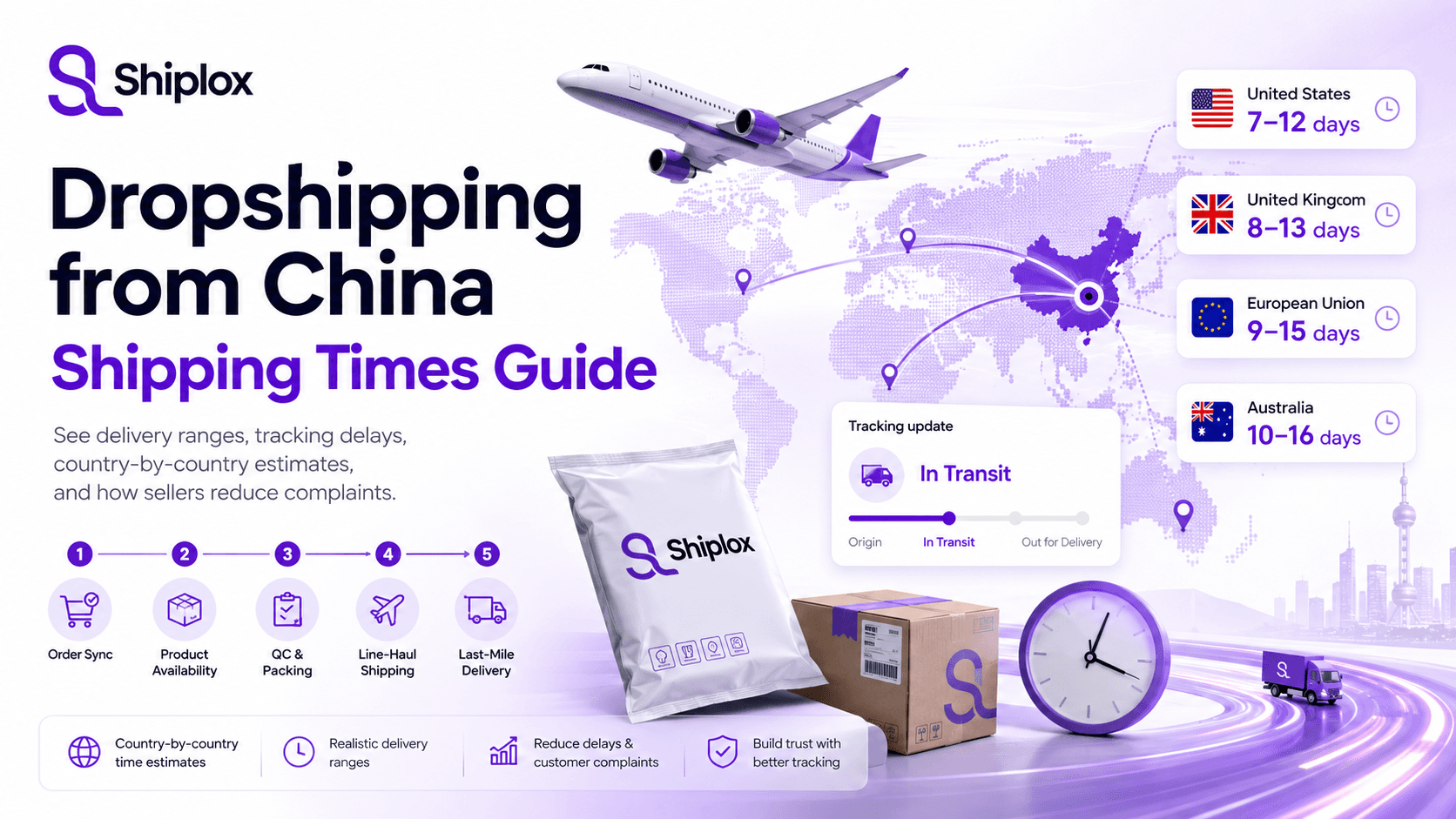
Most China to customer shipping depends on destination, parcel weight, customs, and the shipping line used. A practical range for ecommerce parcels is:
- United States: 7 to 12 days
- United Kingdom: 8 to 13 days
- European Union: 9 to 15 days
- Australia: 10 to 16 days
These ranges can change during peak seasons and public holidays.
The ranges above are planning ranges, not promises for every parcel. The same shipping line can perform differently depending on product category, exact destination, package size, carrier handoff, customs clearance, and local delivery capacity. Rural delivery addresses can also take longer than major cities.
For customer-facing store policies, it is better to show a range that you can meet consistently. If your normal United States delivery range is 7 to 12 days, do not advertise "ships in 5 days" because a few fast shipments arrived early. Customers judge you against the promise they saw before buying.
The full timeline: where time is actually spent
Many sellers only count the international shipping days, but the customer experiences the full timeline from checkout to delivery. That timeline usually includes five parts.
Order sync is the time between the customer placing an order and the fulfillment team receiving clean order data. If orders are copied manually from Shopify, TikTok Shop, Amazon, or WooCommerce, this step can create errors and delays. Automated order sync helps reduce that risk.
Product availability is the time needed to confirm the item exists in the right color, size, variant, and quantity. If you are fulfilling one by one from a supplier, this can be a major source of delay. Stored inventory in a warehouse is usually faster because the product is already available.
Quality check and packing is the time needed to inspect the product, match the SKU, add packaging or inserts, print labels, and prepare the parcel. This step is important because fast shipping does not help if the wrong item reaches the customer.
Export and line-haul shipping is the international movement from China to the destination country. This can include export processing, air freight, customs pre-clearance, and carrier handoff.
Last-mile delivery is the domestic movement from the destination country carrier to the customer's address. This is where local carrier capacity, address quality, weekends, weather, and remote delivery areas can affect the final days.
When customers ask "Where is my order?", they usually do not care which part caused the delay. They care whether the store can explain it clearly. That is why a fulfillment workflow with quick tracking updates matters.
What slows dropshipping shipments down
The biggest delays usually happen before the parcel leaves the warehouse. A supplier may be out of stock, the product may need checking, or the order details may be incomplete.
Customs can also create delays, especially when product descriptions, declared values, or shipping paperwork are unclear.
Other common causes include:
- Incorrect variant selected by the supplier
- Product waiting for restock
- Battery, liquid, cosmetic, magnet, powder, or branded product restrictions
- Missing phone number or incomplete customer address
- Package size higher than expected
- Peak season carrier congestion
- China public holidays or destination country holidays
- Customs questions about product type or declared value
- Tracking number created before the carrier scan appears
The most frustrating delays are preventable warehouse delays. If an order waits several days before the parcel is handed to the carrier, the customer sees no progress and starts to worry. A good process should reduce these gaps by checking inventory, packaging rules, and shipping line selection before orders begin.
How to reduce delivery problems
Use a fulfillment process that checks products before dispatch, stores proven products in a warehouse, and sends tracking quickly after shipment. This gives your customers better updates and reduces support tickets.
Start by separating testing products from proven products. New products can be handled with samples and smaller test orders. Proven products should be moved into a more stable fulfillment flow with clearer stock levels, known packaging, and repeatable shipping rules.
Store winning products close to the supplier base when possible. If a product sells every day, holding stock in a China warehouse can remove supplier restock delays and speed up packing. It also lets the warehouse team learn the product, packaging, and SKU rules.
Define the shipping method by product type and destination. A lightweight phone accessory, a cosmetics item, and a bulky home product may need different shipping lines. The cheapest line is not always the best line if tracking is weak or delivery ranges are inconsistent.
Use realistic parcel data. Shipping estimates depend on weight and size. If a supplier gives the product weight but not the final packed weight, the actual shipping cost and timeline may change after packing. Ask for packed dimensions when possible.
Check products before they leave the warehouse. Visual checks, quantity checks, variant checks, and packaging checks catch problems before the parcel reaches the customer. This is especially important for products with many colors, sizes, bundles, or branded inserts.
Send tracking quickly, but explain the first scan. Some tracking numbers are created before the carrier's first visible scan. Customers may see "label created" or no movement for a short time. Your tracking page or email should explain that updates can appear after the carrier receives and scans the package.
You can also use a public tracking page so customers have a single place to check updates instead of emailing support for every shipment.
What to tell customers
Do not promise the fastest possible delivery date. Promise the realistic delivery range your process can meet most of the time. Clear expectations reduce refund requests and make your store look more professional.
A strong shipping policy should answer:
- How long order processing takes
- How long delivery usually takes by country
- Whether tracking is included
- When tracking starts updating
- What happens if an item is delayed
- What customers should do if the address is wrong
- Whether customs or local delivery delays can occur
Here is a clear structure sellers can adapt:
"Orders are usually processed within 1 to 3 business days. Delivery normally takes 7 to 12 business days for the United States, 8 to 13 business days for the United Kingdom, 9 to 15 business days for most European Union destinations, and 10 to 16 business days for Australia. Tracking is sent when the parcel ships. Some tracking numbers may take 24 to 72 hours to show the first carrier update."
This kind of wording is safer than overpromising. It gives customers a specific range and reduces anxiety during the first few days.
Shipping time by product type
Different product categories behave differently. Small accessories, jewelry, phone stands, beauty tools, and lightweight gadgets are usually easier to ship. They are compact, cheaper to move, and more compatible with standard ecommerce lines.
Products with batteries need more review. Some battery products can ship, but the line, paperwork, packaging, and destination rules matter. The same is true for cosmetics, liquids, powders, magnets, sharp tools, and anything that may trigger carrier restrictions.
Bulky products can have slower or more expensive shipping even when the unit price is low. A product that costs $4 from the factory can become unprofitable if it is large, fragile, or expensive to pack.
Branded or trademark-sensitive products also need caution. Counterfeit or unauthorized branded goods create customs and marketplace risk. A responsible sourcing process should reject products that are unsafe, counterfeit, or not suitable for the destination market.
How Shiplox helps with shipping from China
Shiplox is built for sellers who want product sourcing, warehouse checking, packing, and tracking in one workflow. Instead of messaging suppliers for every order, you can request product pricing, check the landed cost, approve samples when needed, and move proven products into fulfillment.
The important part is visibility. You should know:
- What the product costs
- What shipping is expected to cost
- What delivery range applies by country
- Whether the product needs special handling
- Whether stock is ready in the warehouse
- When tracking is available
For new products, start with a product price request. For proven products, use a repeatable fulfillment setup so orders can move faster from customer checkout to packed shipment.
Final checklist for better shipping times
Before you sell a product at scale, confirm:
- The final packed weight and size
- The destination countries you want to support
- The realistic delivery range for each market
- The product restrictions for batteries, liquids, cosmetics, magnets, or sharp items
- The expected warehouse processing time
- The tracking line and first-scan behavior
- The replacement or refund policy for delayed or damaged parcels
- The exact shipping promise shown on your product page and checkout
Dropshipping from China can work well when expectations are honest and operations are controlled. The sellers who struggle most are usually not the ones with the slowest possible line. They are the ones with unclear promises, no warehouse checks, no stock visibility, and no tracking process customers can trust.