
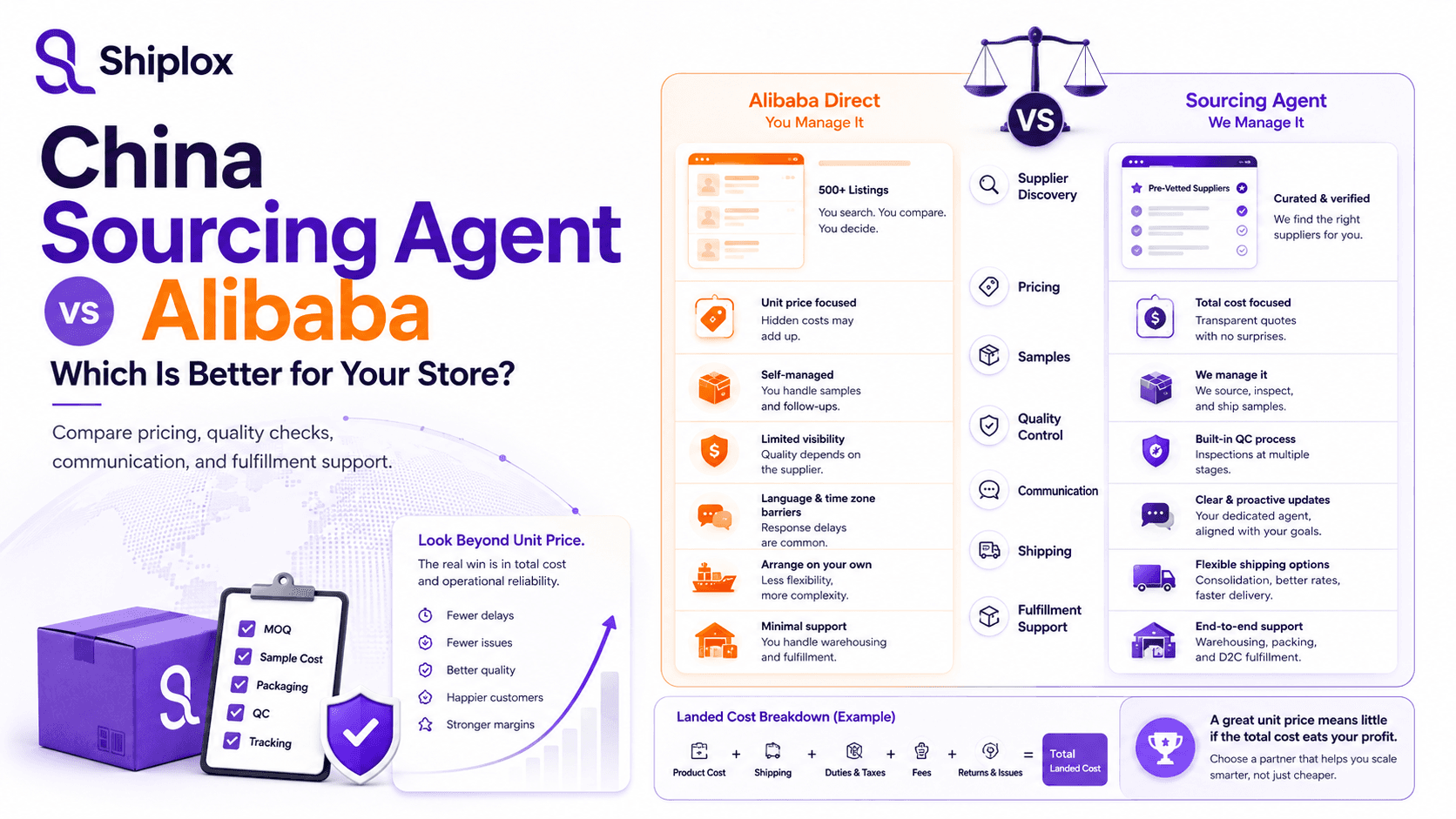
Alibaba is useful when you want to search supplier listings yourself. A China sourcing agent is useful when you want someone on the ground to compare suppliers, confirm product details, arrange samples, check quality, and help manage the work after you choose a product.
Both options can work. The right choice depends on your time, experience, product risk, order volume, packaging needs, and how much operational work you want to manage yourself. Alibaba gives you access. A sourcing agent gives you support. For many ecommerce sellers, the best answer is not "Alibaba or agent forever." It is knowing when to use each one.
This guide compares Alibaba and China sourcing agents across supplier discovery, pricing, communication, samples, quality control, shipping, fulfillment, and risk.
If you already found an agent and need to judge whether they are trustworthy, use the China purchasing agent review checklist after this comparison.
Alibaba is best when you know what you need
Alibaba gives you access to many suppliers. It works well when you already know the product, quantity, specifications, and packaging details.
The challenge is that you still need to compare suppliers, negotiate, order samples, manage quality checks, and arrange shipping.
Alibaba is strongest when you can write a clear sourcing brief. That means you know the product material, dimensions, color, packaging, certifications, target price, quantity, destination country, and acceptable delivery method. If you can send that information to multiple suppliers and compare answers carefully, Alibaba can be a useful research tool.
It is also helpful when you want to understand the market. You can see product variations, supplier locations, rough MOQ ranges, sample availability, and common packaging options. This is valuable early research, especially when you are comparing product ideas.
But Alibaba is not the same as having a managed supply chain. Supplier listings are marketing pages. They do not automatically prove that a supplier is the best factory for your product, that the quote includes the right packaging, that the sample matches mass production, or that the shipping line is suitable for your customers.
Use Alibaba when:
- You already understand the product specification.
- You are comfortable messaging many suppliers.
- You can compare quotes and spot missing details.
- You have time to arrange samples and inspections.
- You are not depending on the supplier for every customer order.
- You can manage freight or fulfillment separately.
A sourcing agent is best when you want help
A sourcing agent can contact multiple factories, compare quotes, inspect samples, and explain the real cost before you buy. This is useful if you do not speak Chinese, do not know the supplier market, or do not want to manage every message yourself.
A good sourcing agent should do more than forward supplier screenshots. The agent should clarify the product, compare realistic options, explain tradeoffs, and help you avoid hidden costs. The value is not only translation. It is judgment.
For ecommerce sellers, the most useful sourcing agent is usually connected to fulfillment. Finding the product is only the first step. You still need sample handling, quality checks, packaging, warehouse intake, inventory tracking, shipping, and customer-ready fulfillment. If those steps are split across different people, mistakes can happen between handoffs.
Use a sourcing agent when:
- You need help turning a product idea into a supplier brief.
- You want multiple factory options compared.
- You need someone to check MOQ, sample cost, and packaging.
- You want product photos or videos before approval.
- You need quality control before shipping.
- You want support with custom packaging or inserts.
- You want the product moved into a fulfillment workflow after sourcing.
You can see how Shiplox connects sourcing and fulfillment on the services page.
Cost comparison: Alibaba vs sourcing agent
Alibaba may look cheaper at first because you are dealing directly with suppliers. But the visible unit price is not the full cost. You still need to account for samples, domestic shipping, inspection, packaging, international shipping, payment fees, customs handling, rejected units, replacement cost, and your own time.
A sourcing agent may add a service fee or margin. That can be worth it if the agent reduces mistakes, finds better supplier options, handles communication, checks products, and helps prevent bad shipments. It is not worth it if the agent hides margins, gives vague answers, or only pushes one supplier without explaining alternatives.
The fair comparison is landed cost and operational reliability, not just unit price.
Ask for pricing separated into:
- Product cost
- Sample cost
- Domestic handling or warehouse intake
- Quality check cost
- Packaging cost
- International shipping cost
- Service fee or margin
If you cannot see these parts, you cannot understand your real gross margin.
Quality control differences
On Alibaba, quality control is your responsibility unless you hire a third-party inspector or negotiate inspection with the supplier. Some suppliers will send photos, but supplier photos are not the same as independent checks. A supplier has an incentive to show the product in the best condition.
A sourcing agent or fulfillment partner can check products when they arrive at the warehouse. This is especially useful for products with variants, logos, bundles, fragile parts, electronics, fabric, cosmetics accessories, or custom packaging.
Quality control should be specific. Instead of saying "check quality," define what needs to be checked:
- Product color and variant
- Quantity and SKU
- Logo position
- Material and finish
- Visible damage
- Function or charging
- Accessories included
- Packaging condition
- Label and barcode accuracy
- Bundle contents
For small orders, a visual check may be enough. For higher-risk products, you may need a more detailed inspection checklist.
Communication and speed
Alibaba communication can be fast at the beginning and slower after details become complex. Time zones, language differences, vague product specs, and supplier sales teams can all create delays. You may need to repeat the same questions to multiple suppliers.
A sourcing agent can reduce that communication load. The agent can ask suppliers in Chinese, clarify technical details, compare answers, and summarize what matters. This is useful when you need fast decisions, but it only works if the agent is organized and transparent.
The best test is a first product request. Send one product link or photo and judge the response. Did the agent ask smart questions? Did they explain MOQ, sample cost, shipping concerns, and next steps? Did they separate product and shipping costs? Did they warn you about risks?
Shipping and fulfillment support
Alibaba suppliers can ship samples and sometimes bulk orders, but customer-by-customer ecommerce fulfillment is a different workflow. A supplier may not want to pack single parcels, add branded inserts, sync tracking to Shopify, or handle returns and replacement logic.
If you are only ordering bulk stock, Alibaba plus a freight forwarder may be enough. If you are running a Shopify or TikTok Shop store and need individual customer orders shipped daily, you need a fulfillment process.
That process should include:
- Store order sync
- SKU matching
- Warehouse stock visibility
- Pick and pack handling
- Packaging rules
- Tracking numbers
- Delivery ranges by country
- Support for delayed or damaged orders
For many sellers, this is where a sourcing agent connected to a warehouse becomes more useful than Alibaba alone.
What to watch out for
Some agents hide margins or only work with a small supplier network. Always ask how they charge, how they compare suppliers, and whether they can show product, shipping, and service costs clearly.
Also watch for agents who say yes to every product. Some products are not worth sourcing because the shipping cost is too high, the product is too fragile, the supplier market is inconsistent, or the destination country has restrictions. A reliable partner should be willing to tell you when a product is a bad fit.
Be careful with:
- Vague "best price" claims without supplier comparison
- No sample process
- No warehouse address or operations detail
- No clear fee structure
- No product check process
- No written quote breakdown
- No tracking workflow
- Pressure to pay before details are confirmed
- Counterfeit or restricted products
You do not need perfection from the first message, but you do need transparency.
Which one should you choose?
Use Alibaba if you are comfortable managing supplier research yourself. Use a sourcing partner if you want faster comparison, clearer quality checks, and fulfillment support after sourcing.
For many growing stores, the best setup is simple: use Alibaba or market research to discover product ideas, then use a sourcing and fulfillment partner to validate the product, order samples, check quality, and move winners into a repeatable fulfillment process.
Choose Alibaba when the product is simple, you know exactly what to ask, and you have time to manage the details. Choose a sourcing agent when the product has risk, the supplier market is confusing, you need packaging help, or you want support after sourcing.
Final decision checklist
Before deciding, answer these questions:
- Do I know the exact product specification?
- Can I compare supplier quotes myself?
- Do I understand MOQ, sample cost, and packaging cost?
- Do I need custom branding or inserts?
- Do I need a product checked before shipping?
- Do I need single customer orders fulfilled from China?
- Do I have time to manage supplier messages every week?
- Do I know my landed cost and target margin?
- Do I need tracking synced back to my store?
If most answers are yes, Alibaba may be enough for early supplier research. If many answers are no, a sourcing partner can reduce risk and save time.
Shiplox is designed for sellers who want sourcing and fulfillment connected. You can start with one product price request, compare the real landed cost, order a sample if needed, then move the product into warehouse storage or order fulfillment when it is ready.
Frequently asked questions
Is a China sourcing agent cheaper than Alibaba?
Not always cheaper upfront, but often cheaper in total. Alibaba shows a unit price, but you still pay for samples, domestic shipping, inspection, customs handling, and your own time. A sourcing agent may add a service fee or margin, but can also find better factories, catch expensive mistakes, and reduce the total landed cost per order. Always compare landed cost, not just unit price.
Do I need a sourcing agent if I already use Alibaba?
Not necessarily. If you already know the product specification, can compare supplier quotes yourself, and are comfortable managing quality checks and shipping, Alibaba may be enough. A sourcing agent adds the most value when the product has quality risk, the supplier market is hard to navigate, you need custom packaging, or you want fulfillment support after the product is sourced.
How much does a China sourcing agent charge?
Sourcing agents typically charge a service fee, a margin on the product price, or a percentage of the order value (usually 5–15%). Some agents are free upfront but build margin into the unit cost. Always ask for the product cost, service fee, and shipping cost listed separately so you can calculate real landed cost and compare options fairly.
Can a sourcing agent help with quality control?
Yes. A good sourcing agent should check products before they leave China — confirming quantity received, visible defects, variant matching, and packaging. This pre-shipment check is one of the main reasons sellers use an agent instead of ordering directly from a marketplace supplier. Shiplox includes quality checks as part of every fulfillment workflow.
What is the difference between a sourcing agent and Alibaba?
Alibaba is a supplier marketplace — you search listings, contact manufacturers directly, and manage sourcing yourself. A sourcing agent is a person or team that does the supplier search for you: comparing factories, negotiating price, arranging samples, checking quality, and managing the operational steps between your product idea and a ready-to-ship order. See the full comparison of Shiplox vs Alibaba including cost breakdowns and use cases.