
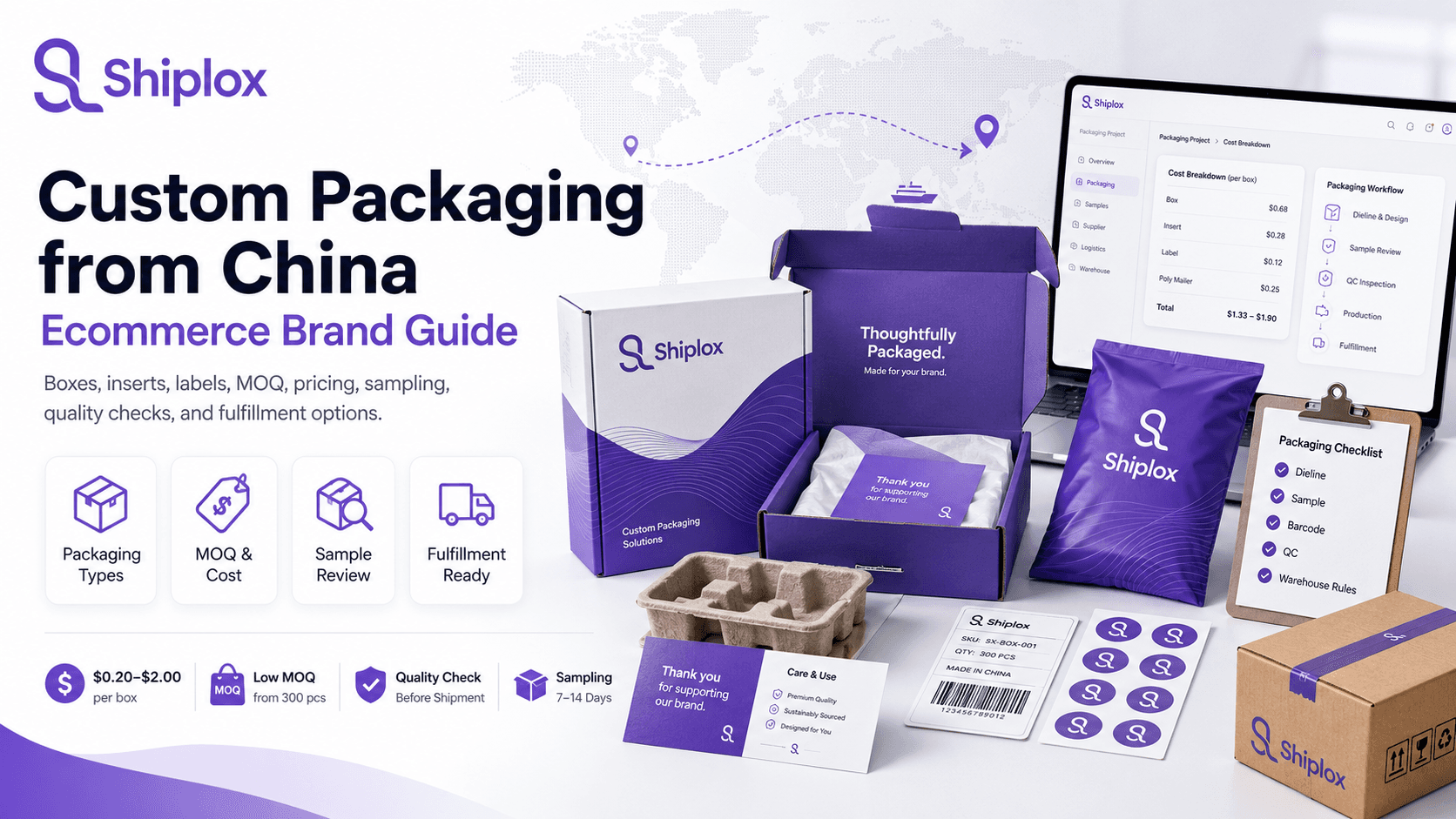
Custom packaging from China can make a small ecommerce brand feel more established, protect products during shipping, and give customers a better first impression when the parcel arrives.
It can also become expensive or messy if the packaging is designed before the product, supplier, shipping method, and fulfillment workflow are clear.
The best packaging setup is not always the most beautiful box. It is the packaging that protects the product, fits the shipping channel, matches the brand, stays inside margin, and can be repeated by a warehouse team without confusion.
This guide explains how custom packaging from China works for ecommerce sellers, what options are realistic, how MOQ affects cost, what artwork files you need, how sampling should work, and what to check before branded packaging is used for customer orders.
What custom packaging from China means
Custom packaging means any packaging material made or prepared for your brand instead of using only a supplier's standard packaging. It can be simple, like a logo sticker on a mailer, or more involved, like a custom printed box with an insert card, barcode label, product sleeve, and protective inner tray.
For ecommerce brands sourcing from China, packaging usually sits between three teams:
- The product supplier, who may offer basic product packaging.
- The packaging supplier, who makes boxes, bags, labels, cards, or inserts.
- The warehouse or fulfillment partner, who receives products and uses the packaging for orders.
Problems happen when those teams are separated. A supplier may make a nice box that is too large for affordable parcel shipping. A packaging vendor may print the right design but use a weak material. A warehouse may receive branded inserts but have no written rule for which SKU uses which card.
That is why packaging should be planned as part of the sourcing and fulfillment process, not as a decoration added at the end. If you are still comparing suppliers, start with product details first. We explain that supplier decision path in China Sourcing Agent vs Alibaba.
Why ecommerce brands use custom packaging
Custom packaging is useful when it solves a business problem. It should support trust, protection, repeat purchases, or operational clarity.
Common reasons include:
- Making a new brand feel more professional.
- Protecting fragile or premium products.
- Explaining how to use the product.
- Adding a thank-you card, care guide, QR code, or reorder message.
- Separating product variants with labels or color-coded packaging.
- Creating a better unboxing experience for social content.
- Supporting retail or gift-ready presentation.
- Reducing customer confusion after delivery.
Packaging is not only about looks. It can reduce support tickets if the product needs instructions. It can lower damage rates if the product is packed correctly. It can improve repeat purchase rate if customers understand the brand and know where to reorder.
It can also hurt the business if it increases shipping weight, creates delays, or forces you into a high minimum order before the product has proven demand.
Custom packaging options by difficulty
Not every seller should start with a fully custom box. A staged approach is usually better because you can improve brand presentation without locking too much cash into packaging inventory.
| Packaging option | Best for | Typical complexity |
|---|---|---|
| Logo sticker | Early tests, low MOQ branding | Low |
| Thank-you card or insert | Brand story, reorder CTA, instructions | Low |
| Barcode or SKU label | Warehouse accuracy, variant control | Low |
| Branded poly mailer | Apparel, soft goods, lightweight products | Medium |
| Printed product sleeve | Cosmetics, accessories, gift products | Medium |
| Custom color box | Premium products, retail-style presentation | Medium to high |
| Rigid gift box | Luxury items, influencer kits | High |
| Molded insert or tray | Fragile, shaped, or multi-part products | High |
For most ecommerce sellers, the first strong setup is not a rigid box. It is a standard protective parcel with a branded card, correct SKU label, and maybe a small logo sticker or sleeve. This gives the customer a brand moment without making shipping too expensive.
Once a product is selling consistently, you can move into printed boxes or more advanced inserts.
MOQ: the number that controls packaging decisions
MOQ means minimum order quantity. Custom packaging from China often has a separate MOQ from the product itself. A product supplier may accept 100 units, but a packaging supplier may want 500, 1,000, or 3,000 printed boxes.
This matters because packaging inventory can become dead stock if the product changes, the logo changes, the product does not sell, or the box size is wrong.
Before approving custom packaging, ask:
- What is the MOQ for this packaging material?
- Does the MOQ change by size, color, or print method?
- Can the supplier make a plain sample before printing?
- Can the design be used for multiple SKUs?
- How much space will the packaging inventory use?
- What happens if the product size changes later?
If you are testing a new product, avoid packaging that only works for one SKU unless the order volume already supports it. A flexible insert card or sticker can often support several products while you learn what sells.
For sellers starting with lower quantities, Shiplox usually recommends proving the product first, then increasing the packaging commitment after the first customer orders are clear. The pricing page can help you compare the cost categories that sit around sourcing and fulfillment.
Product packaging vs shipping packaging
Product packaging is what directly holds or presents the item. Shipping packaging is what protects the order during transport.
This difference is important.
A printed product box may look good in photos, but it may still need a mailer, carton, bubble wrap, corner protection, or inner fill to survive international shipping. If you use the printed product box as the shipping box, it may arrive crushed, dirty, or covered in labels.
Think about the full packaging stack:
- Product protection, such as bag, sleeve, tray, pouch, foam, or wrap.
- Brand presentation, such as printed box, card, sticker, or label.
- Warehouse identification, such as SKU label, barcode, color, or variant marker.
- Parcel protection, such as mailer, carton, bubble wrap, paper fill, or corner support.
- Shipping label and compliance labels, depending on destination and product type.
Many packaging mistakes happen because sellers design step 2 and ignore steps 1, 3, 4, and 5.
What to prepare before asking for a packaging quote
You will get better quotes if you send a clear brief. A vague request like "I need custom packaging" forces suppliers to guess, which usually creates wrong prices.
Prepare these details:
- Product dimensions and weight.
- Product material and fragility.
- Quantity for first order and target monthly volume.
- Destination countries.
- Sales channel, such as Shopify, TikTok Shop, Amazon, WooCommerce, or retail.
- Packaging goal, such as protection, branding, instructions, gifting, or bundling.
- Preferred packaging type, if known.
- Brand colors, logo files, and font rules.
- Required barcode, SKU, size, color, or variant labels.
- Insert card text or QR code destination.
- Any claims that need review, such as eco, organic, child-safe, food contact, or medical-style wording.
If you are not sure what packaging type fits the product, send product photos and the target customer experience. A good sourcing or packaging partner should be able to suggest a simple option, a better option, and a premium option.
You can submit product and packaging details through the Shiplox services workflow when you want sourcing, sample review, packaging, warehouse intake, and fulfillment connected.
Artwork files and dielines
Packaging artwork needs to fit the physical shape of the box, sleeve, label, or card. A dieline is the flat template that shows cut lines, fold lines, bleed area, safe area, and print panels.
For custom packaging, ask the supplier for the dieline before final artwork is created. Do not design only from a screenshot or rough box size.
Your designer should prepare:
- Vector logo files, usually AI, EPS, SVG, or PDF.
- Print-ready PDF using the supplier's dieline.
- CMYK color values when print color matters.
- Bleed area where artwork extends past cut lines.
- Safe area so text is not cut off or folded.
- Correct barcode or QR code size.
- Font outlines or embedded fonts.
If you do not have a designer, keep the first packaging design simple. A clean logo, clear product name, and one brand color are usually safer than a crowded design with small text and complicated gradients.
The warehouse should also receive the final approved artwork file or packaging photo. That makes it easier to confirm the correct packaging arrived before customer orders go out.
Sampling before mass production
Never approve custom packaging based only on a digital mockup. Printed color, paper thickness, folds, glue, box strength, and product fit can all look different in real life.
A proper sampling process usually has two stages.
First, request a structural sample. This checks size, fold, strength, and product fit. It may be plain white or unprinted. The goal is to confirm that the product fits and the packaging protects it.
Second, request a printed sample or print proof. This checks logo position, color, text, QR code, barcode, finish, and general presentation.
When reviewing samples, check:
- Does the product fit without pressure or rattling?
- Does the box close cleanly?
- Does the material feel strong enough?
- Are edges, folds, glue, and corners clean?
- Is the logo sharp?
- Is the color close enough to brand expectations?
- Can the barcode or QR code scan?
- Is the text readable on mobile photos and in real life?
- Does the packaging add too much size or weight?
If the packaging will be used for ecommerce shipping, ask for a packed parcel photo or test shipment. The package needs to look good after transport, not only on a supplier desk.
Cost areas to compare
Custom packaging cost is not only the unit price of the box. You need the full packaging cost inside the order.
Compare:
- Design or dieline support.
- Sample cost.
- Printing setup fee.
- Packaging unit cost.
- Domestic shipping from packaging supplier to warehouse.
- Storage space for empty packaging.
- Extra packing labor if the packaging needs assembly.
- Added parcel weight or dimensional weight.
- Waste from damaged or outdated packaging.
A box that costs $0.45 may become much more expensive if it increases shipping cost by $1.20. A card that costs $0.06 may be a better first move if it improves the customer experience without changing parcel size.
This is why packaging decisions should be tested with real product weight and parcel dimensions. If you are shipping internationally from China, delivery time and cost are affected by weight, size, product category, destination, and carrier line. We cover delivery expectations in Dropshipping from China Shipping Times.
Custom packaging and warehouse accuracy
Good packaging also helps the warehouse pack orders correctly. This matters when you have variants, bundles, or products that look similar.
For example, a black size M product and a black size L product may look almost identical. If the only difference is a tiny supplier sticker, mistakes can happen. A clearer SKU label, barcode, color marker, or variant label can reduce wrong-item shipments.
Packaging rules should be written before fulfillment starts:
- Which SKU uses which box, bag, card, or sticker?
- Where should the barcode label be placed?
- Should the supplier's original label stay or be removed?
- Does every order get an insert card?
- Do wholesale, sample, VIP, or replacement orders use different packaging?
- How should bundles be assembled?
- What should the warehouse do if branded packaging runs out?
If these rules are not documented, warehouse workers have to guess. That is when a brand experience becomes inconsistent.
Shiplox connects packaging decisions to warehouse handling through the China warehouse for ecommerce workflow so the product, packaging, stock, and order rules are managed together.
Packaging for Shopify and ecommerce platforms
Shopify sellers often need packaging rules tied to SKUs and variants. The product title customers see in Shopify may not be enough for warehouse picking. You need clear SKU naming and packaging rules behind the scenes.
For Shopify fulfillment from China, confirm:
- Every product variant has a unique SKU.
- The SKU matches warehouse inventory.
- Packaging materials are assigned to the correct SKU.
- Bundle products have written assembly rules.
- Tracking can sync back after dispatch.
- Packaging stock is monitored before it runs out.
If you sell the same product in multiple countries, be careful with printed instructions and claims. A card written only for the United States may not make sense for European or Australian customers. Use simple universal language unless a market needs a specific version.
You can read more about order sync and store operations on the Shopify fulfillment from China page.
Compliance and claims to avoid
Packaging text can create risk. Be careful with claims that may require proof or country-specific review.
Examples include:
- Eco-friendly
- Biodegradable
- Compostable
- Organic
- Medical grade
- Child safe
- FDA approved
- CE certified
- Non-toxic
- Food safe
Some claims may be valid if you have the right documentation. Others may be misleading or restricted depending on product and destination country. If the product touches food, skin, children, pets, electronics, cosmetics, or health use, review claims carefully before printing them on packaging.
For early packaging, use safer language. Explain what the product is, how to use it, how to contact support, and where to reorder. Avoid legal, safety, or environmental claims unless they are verified.
Red flags when ordering custom packaging
Be careful if a packaging supplier or sourcing partner cannot explain the practical details.
Red flags include:
- No dieline before artwork approval.
- No physical sample before mass production.
- No material thickness or paper specification.
- MOQ changes after artwork is submitted.
- No explanation of printing setup fees.
- No packed product photo.
- No barcode or QR code scan check.
- No carton quantity or storage estimate.
- No written packaging rule for the warehouse.
- No plan if packaging arrives late.
The biggest risk is not a slightly imperfect box. The bigger risk is printing hundreds or thousands of units that do not fit the product, confuse the warehouse, or make shipping too expensive.
A practical packaging rollout plan
For most ecommerce brands, custom packaging should be rolled out in stages.
Stage one is validation. Use standard protective packaging with a simple insert card or sticker. Focus on product quality, delivery time, and customer feedback.
Stage two is consistency. Add SKU labels, barcodes, variant labels, and written packing rules. This reduces warehouse errors and makes support easier.
Stage three is brand upgrade. Add printed sleeves, branded mailers, or a custom color box once the product has proven order volume.
Stage four is premium packaging. Use molded inserts, rigid boxes, multi-part kits, or special finishes for products with stable demand and strong margin.
This staged approach protects cash. It also gives you time to learn from real customer orders before committing to packaging inventory.
Custom packaging checklist
Before approving custom packaging from China, confirm:
- The product dimensions and packed weight are known.
- The packaging type matches product risk and customer expectation.
- MOQ is realistic for your order volume.
- The dieline has been reviewed.
- Artwork is print-ready.
- A physical sample has been checked.
- Barcode or QR code scans correctly.
- Packaging does not push shipping cost too high.
- Warehouse packing rules are written.
- Packaging stock can be tracked.
- Claims and instructions are safe for destination markets.
- There is a backup plan if branded packaging runs out.
Custom packaging should make the customer experience clearer and the operation stronger. If it only makes the box prettier while adding cost, delay, and confusion, it is too early.
Final advice for ecommerce sellers
Start with the product, margin, and fulfillment workflow. Then choose packaging that supports those pieces.
If you are still testing the product, use flexible low-MOQ branding like inserts, stickers, labels, or sleeves. If the product is proven, move toward custom boxes or premium packaging after you know the real packed weight, shipping cost, customer feedback, and reorder volume.
The best custom packaging from China is not designed in isolation. It is planned with sourcing, samples, quality checks, warehouse intake, SKU labels, packed parcel dimensions, and shipping rules in mind.
Shiplox can help sellers review product options, compare packaging choices, check samples, receive stock in China, pack orders, and ship with tracking from one workflow. Start with one product and one clear packaging goal, then scale the packaging only when the product earns it.