
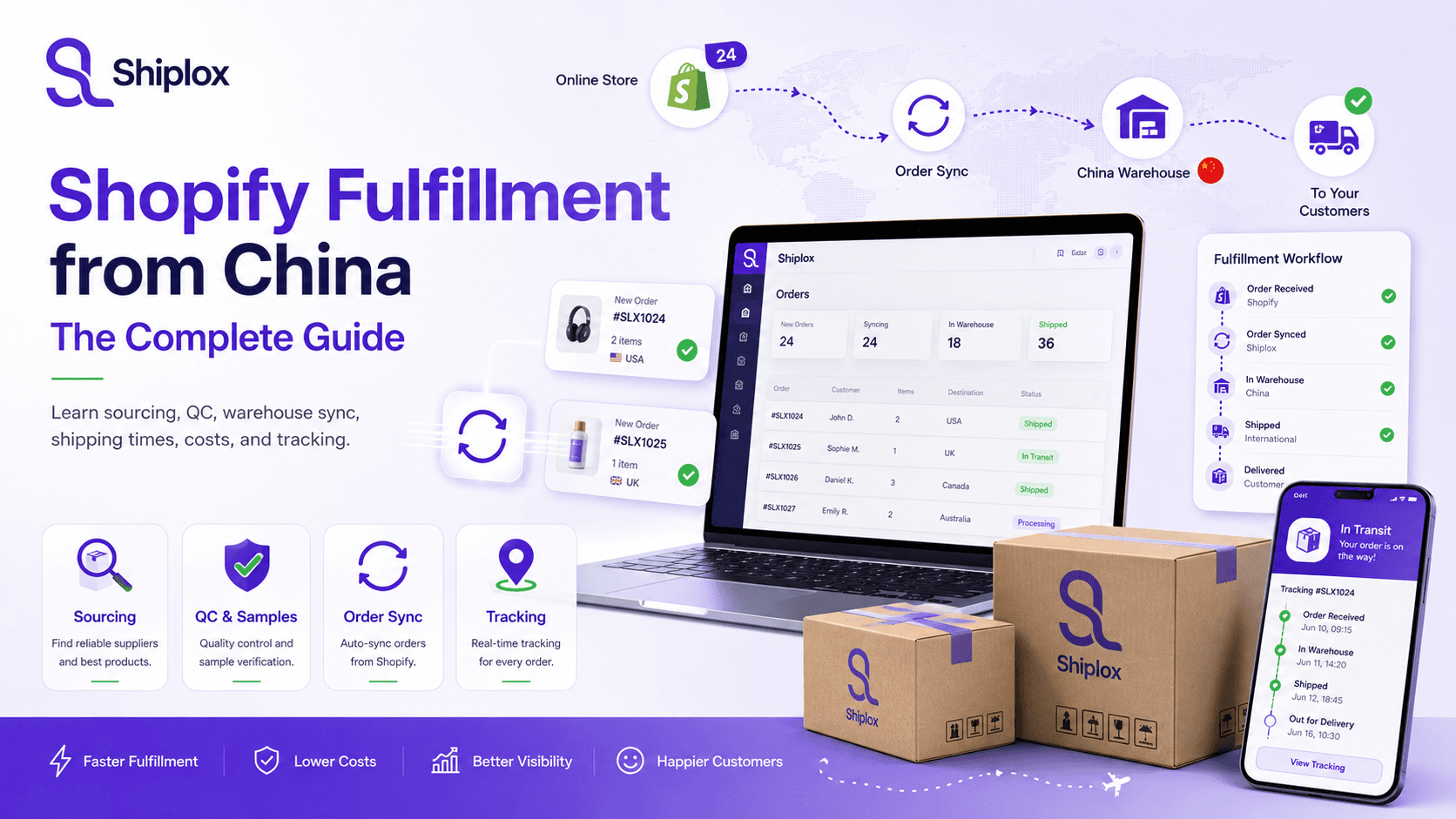
Shopify fulfillment from China means your store orders are handled close to the supplier base. Instead of buying products from a factory, shipping them to your home country, storing them again, and then sending each parcel to the final customer, a China fulfillment partner can source, check, pack, and ship orders before inventory leaves China.
For Shopify sellers, the main advantage is control. You can keep supplier communication, warehouse intake, quality checks, packing, shipping, and tracking inside one repeatable process. This matters because fulfillment problems rarely come from one single mistake. They come from small gaps: unclear product specs, a supplier shipping the wrong variant, missing packaging instructions, slow tracking updates, or a customer support team that does not know what happened to the parcel.
This guide explains when Shopify fulfillment from China makes sense, how the workflow should operate, what costs to expect, what questions to ask before choosing a partner, and how to avoid common mistakes that create refunds and bad reviews.
When China fulfillment makes sense
China fulfillment works best when your products are manufactured in China or nearby supplier markets. If your store sells gadgets, beauty accessories, home goods, pet products, fitness items, packaging-heavy bundles, or custom branded products, China is often where the supplier network, packaging vendors, and freight lines already exist.
It is also useful when speed matters but you are not ready to import bulk stock to a local 3PL. A small Shopify store can start with samples, test demand, and move winning products into stored inventory once sales become predictable. A larger store can use China fulfillment to reduce landed cost, improve supplier control, and keep packaging work close to the factory.
China fulfillment is usually a strong fit when:
- Your supplier or product category is already based in China.
- You need samples before approving bulk stock.
- You want product checks before parcels ship to customers.
- You need custom boxes, cards, inserts, stickers, labels, or bundles.
- You sell to multiple countries and want one export workflow.
- You want tracking sent back to Shopify after each shipment.
- You want to avoid managing supplier messages for every order.
It may not be the best fit if your products are made locally, if customers require same-day domestic delivery, or if your product is heavily regulated in the destination country and needs a specialized importer, certification process, or local compliance partner.
What your fulfillment partner should handle
A useful partner should cover the operational work that usually slows a seller down:
- Product and supplier search
- Unit price comparison
- Sample ordering
- Product checks before shipping
- Packing and inserts
- International shipping
- Tracking updates
- Store order sync
If a provider only gives you a shipping label, you still need to manage sourcing, quality control, and supplier communication yourself.
How the Shopify fulfillment workflow should work
A reliable workflow should be simple enough for a seller to understand but detailed enough to prevent expensive mistakes.
First, the product is sourced or approved. You send a product link, product photo, supplier link, or product brief. The fulfillment team checks supplier options, compares unit cost, confirms minimum order quantity, reviews packaging requirements, and explains whether the product is practical for ecommerce shipping.
Second, you order a sample when needed. Samples are not only for checking product quality. They help confirm size, material, color, weight, packaging, battery type, included accessories, and whether the item can survive parcel delivery. Skipping samples can save a few days, but it increases the risk of chargebacks and returns later.
Third, inventory is prepared. For one-by-one fulfillment, the partner may buy or receive products as orders come in. For faster delivery, you can hold stock in a China warehouse. Stored stock gives the warehouse team a known SKU, known packaging, and a cleaner pick-and-pack process.
Fourth, Shopify orders sync into the fulfillment workflow. The best setup avoids CSV files and manual copying. New orders should include recipient name, shipping address, product, SKU, quantity, variant, and any note needed for packing.
Fifth, the warehouse checks and packs the order. This can include visual inspection, barcode or SKU matching, packaging insert placement, custom label application, bundle assembly, and final parcel measurement.
Sixth, the parcel ships and tracking goes back to Shopify. The buyer receives an update, your support team has the tracking number, and the order can be marked fulfilled in your store.
You can see how Shiplox structures this on the services page and compare cost stages on the pricing page.
What Shopify sellers usually pay for
Shopify fulfillment from China is not one single fee. A transparent quote should separate the major cost parts:
Product cost is the factory or supplier price for the item. This changes by quantity, material, color, packaging, and supplier.
Inbound or warehouse intake cost covers moving goods from supplier to warehouse, checking cartons, counting units, and preparing inventory.
Quality check cost covers inspection work before products are stored or shipped. The level of inspection should match the risk of the product.
Packing cost covers pick, pack, labels, inserts, bubble wrap, cartons, and other handling work.
Shipping cost depends on destination country, parcel weight, parcel size, product category, service line, and delivery speed.
Service fee covers the operational work that keeps the process managed instead of fragmented across suppliers, freight agents, and manual spreadsheets.
Custom packaging cost is separate when you need branded boxes, printed cards, stickers, poly mailers, product labels, or bundle assembly.
If a provider gives one vague price without separating these parts, it becomes harder to understand your margin. A clear landed cost lets you set retail price, shipping policy, return policy, and promotion strategy with fewer surprises.
What to check before choosing a Shopify fulfillment provider
Before choosing a provider, ask direct operational questions. Good answers should be specific, not vague.
Ask where the warehouse is located. A warehouse in or near Shenzhen can be useful because many suppliers, packaging vendors, and export lines are nearby.
Ask how product requests are handled. You want to know whether the team compares multiple suppliers, checks MOQ, reviews shipping restrictions, and gives you a real recommendation.
Ask how samples work. A serious partner should be able to arrange a sample, show photos or videos, explain defects, and help you decide whether to continue.
Ask how Shopify orders are received. If the process depends on manual spreadsheets, mistakes become more likely as order volume grows.
Ask what quality checks are included. Some products only need a visual check. Others need size, color, function, charging, packaging, or count verification.
Ask how damaged or defective products are handled. You need a clear replacement or refund process before customers complain.
Ask how tracking is returned. Tracking should reach Shopify quickly, and the tracking format should be usable for customer emails and support replies.
Ask what happens during holidays and peak season. China public holidays, carrier congestion, and destination customs delays can all affect delivery.
Ask how pricing is shown. You want product cost, shipping cost, service work, and optional packaging separated before you approve.
Ask whether the provider can support your target countries. A store selling to the United States, United Kingdom, European Union, Australia, and Canada may need different shipping lines and customs handling for each market.
How Shiplox fits
Shiplox is built for online sellers who want one place to source products from China, check quality, store inventory, pack orders, and ship to customers. You can request a product price first, order a sample when needed, and move into fulfillment only when the product is ready.
The workflow is designed around clear steps:
- Send a product link, photo, or brief.
- Get a supplier and shipping review.
- Approve the quote or request a sample.
- Store stock or fulfill orders as needed.
- Let the warehouse check, pack, and ship.
- Send tracking back to your store and customer.
This is different from only using a supplier. A supplier may manufacture or sell the item, but they may not manage Shopify order sync, customer-ready packaging, inspection, shipping route selection, and tracking communication. A fulfillment partner should connect those steps.
Common mistakes to avoid
The first mistake is choosing only by the cheapest unit price. A low product cost is not helpful if the supplier ships inconsistent quality, wrong variants, or packaging that gets damaged in transit.
The second mistake is ignoring parcel weight and size. Two products with the same factory cost can have very different shipping costs if one is bulky or fragile.
The third mistake is promising unrealistic delivery times. If your best-case line is 7 days but your normal range is 7 to 12 days, use the realistic range in your store policy.
The fourth mistake is leaving packaging decisions too late. Custom packaging often needs design files, sample checks, MOQ review, and production time. It should be planned before launch, not after orders start.
The fifth mistake is failing to define quality checks. "Check quality" can mean many things. Write down what needs to be checked: color, material, size, logo position, charging, accessories, packaging, count, or damage.
The sixth mistake is not testing the full customer experience. Order a sample like a real buyer and look at the product, parcel, tracking email, delivery time, and support process.
Final checklist before you start
Before you connect your store, make sure you know:
- Your target product
- Expected order volume
- Main customer countries
- Packaging needs
- Whether you need samples first
- Whether the product has batteries, liquids, cosmetics, magnets, sharp parts, or compliance restrictions
- Your target delivery promise
- Your acceptable defect or replacement policy
- Your retail price and target gross margin
Once those are clear, a China fulfillment setup can remove a large amount of daily manual work from your Shopify store. The goal is not only cheaper shipping. The goal is a repeatable operating system where products are sourced clearly, checked before shipment, packed correctly, shipped with tracking, and supported when something goes wrong.
For sellers who want a practical first step, start with one product. Request a price, check the landed cost, order a sample if needed, and only then decide whether to store inventory or fulfill customer orders from China.