
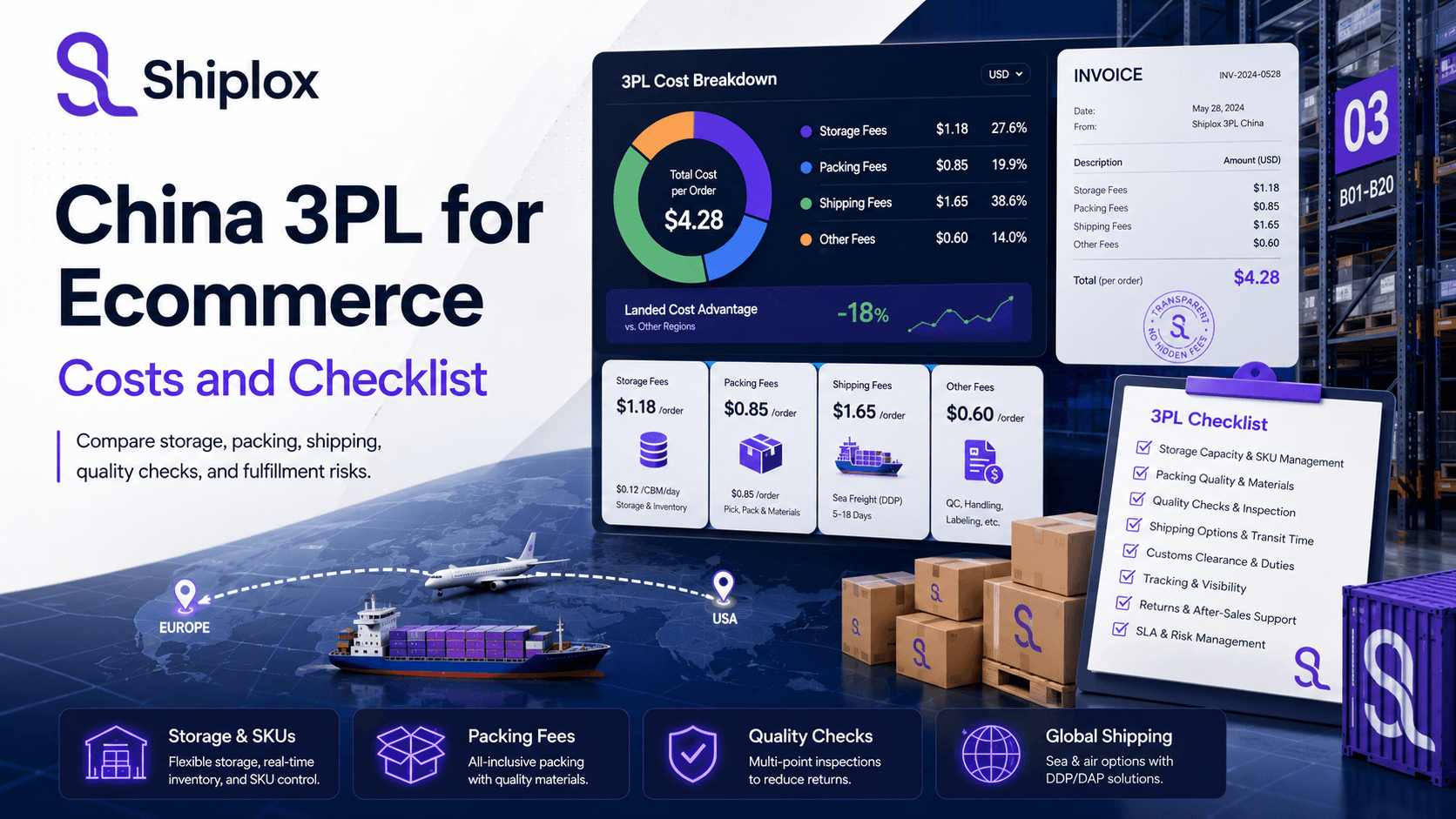
A China 3PL can help ecommerce sellers store inventory near suppliers, pack orders, ship parcels worldwide, and keep tracking visible without building an operations team in China.
The right partner can reduce supplier chasing, make product checks more consistent, and help sellers understand the real cost of fulfillment before scaling ads or launching new products.
The wrong partner can create the opposite problem: unclear stock counts, hidden fees, late tracking, damaged parcels, weak communication, and customers asking where their orders are.
This guide explains what a China 3PL does, when it makes sense, what it usually costs, what to check before choosing one, and how to test a provider before sending serious inventory.
If you want the service workflow after reviewing this checklist, see Shiplox China 3PL warehousing and fulfillment.
What is a China 3PL?
A China 3PL is a third-party logistics partner based in China that handles ecommerce operations after products are manufactured or purchased. A basic 3PL receives inventory, stores it by SKU, picks items when orders arrive, packs parcels, arranges shipping, and provides tracking.
A stronger China 3PL also helps before the warehouse stage. That can include product sourcing, supplier comparison, sample coordination, quality checks, packaging support, shipping method review, and order sync for Shopify or other stores.
For ecommerce sellers, this is important because the supplier is not always the best fulfillment partner. Suppliers may be good at manufacturing or wholesale orders, but they may not be set up for daily customer parcels, branded packaging, tracking updates, or SKU-level warehouse visibility.
A China 3PL sits between the supplier and the customer. It gives the seller a place to control stock, check products, prepare packaging, and ship orders without moving everything to a domestic warehouse first.
When a China 3PL makes sense
A China 3PL makes the most sense when your products are made in China or sourced from Chinese supplier markets. If the product is already near Shenzhen, Yiwu, Guangzhou, or another supplier region, keeping inventory in China can reduce unnecessary handoffs.
It is useful when you are testing products and do not yet want to import bulk stock to a local warehouse. You can start with samples, approve a small inventory batch, store it in China, and ship customer orders from there.
It is also useful when you sell internationally. A domestic warehouse may be excellent for one main country, but a China 3PL can help ship to the United States, United Kingdom, European Union, Australia, Canada, and other markets from one inventory pool.
Common signs that a China 3PL may fit your store:
- Your supplier or product category is based in China.
- You want product checks before shipment.
- You need custom packaging, inserts, bundles, or labels.
- You ship to several countries.
- You are not ready to commit to a domestic 3PL.
- You want clearer control than supplier-direct dropshipping.
- You need tracking sent back to Shopify, TikTok Shop, Amazon, WooCommerce, or another store.
- You want one workflow for sourcing, storage, packing, shipping, and tracking.
If your best-selling SKU has stable demand in one country and customers expect two-day delivery, a local 3PL may be better for that SKU. Many stores eventually use both: a China 3PL for product testing, international orders, and supplier-close operations, plus a domestic 3PL for proven local inventory.
China 3PL vs domestic 3PL
A domestic 3PL is usually closer to the final customer. That can mean faster delivery, easier returns, and a delivery promise that feels familiar to local buyers. It can be the right choice when you have predictable demand and enough inventory to justify importing stock.
A China 3PL is usually closer to the factory and packaging vendors. That can make it easier to source products, order samples, fix supplier mistakes, hold smaller batches, customize packaging, and ship internationally from one origin.
The choice depends on your product stage.
Use a China 3PL when you are testing products, sourcing from Chinese suppliers, shipping worldwide, or still improving packaging and quality control.
Use a domestic 3PL when the product is already proven, demand is predictable, and your main market needs faster local delivery.
Use both when your business has a mix of proven products and new tests. For example, you may keep hero SKUs in a United States warehouse while using a China 3PL for new product launches, EU orders, Australian orders, or SKUs that are still being refined.
What a good China 3PL should handle
A good China 3PL should do more than print labels. It should make the order path visible from supplier to customer.
At minimum, a useful partner should handle:
- Supplier-to-warehouse receiving
- SKU and variant matching
- Inventory counts
- Basic visual checks
- Storage by product or SKU
- Pick and pack work
- Packaging materials
- Tracking numbers
- International parcel shipping
- Delivery issue support
For ecommerce brands, stronger partners can also support:
- Product sourcing from China
- Sample coordination
- Product photos or videos before approval
- Custom boxes, labels, cards, and inserts
- Bundle assembly
- Shopify order sync
- Stock alerts and replenishment planning
- Clear delivery ranges by country
This is the difference between a warehouse and an operating partner. A warehouse stores products. An operating partner helps make sure the product, packaging, stock, shipping, and customer communication fit together.
You can see how Shiplox connects these pieces on the China warehouse for ecommerce and services pages.
China 3PL costs to compare
China 3PL pricing can be confusing because sellers often compare only the pick-and-pack fee or shipping rate. That is not enough. The real cost of fulfillment includes every step needed to get the product from supplier to customer. The industry cost layers below are useful comparison points; Shiplox charges $0 for sourcing, basic QC, receiving, storage, Shopify sync, and fulfillment service, while the seller pays for goods and approved third-party costs.
Compare these cost areas before choosing a partner.
Product cost
If the 3PL also helps with sourcing, the product cost should be shown clearly. Ask whether the price is a factory quote, marketplace quote, or agent quote. Ask whether it changes by quantity, color, material, packaging, or supplier.
Do not assume the lowest product price is best. A cheap product can become expensive if it has defects, bad packaging, inconsistent variants, or high shipping weight.
Domestic China handling
Stock usually needs to move from the supplier to the warehouse. This can include supplier pickup, domestic courier cost, carton receiving, warehouse intake, and product count. If these costs are not explained, your margin may be less clear than it looks.
Storage
Many 3PLs price storage by space and time. Shiplox charges a $0 storage-service fee for supported active sellers, including sellers whose orders move slowly, while product-specific or exceptional conditions should be agreed with the private agent before stock arrives.
Ask how storage is calculated. It may be by cubic meter, shelf space, pallet, carton, SKU, or time period.
Quality checks
Some partners include basic visual checks. Others charge for inspection photos, video confirmation, function testing, detailed sampling, or repacking.
This is not a problem if it is clear. It becomes a problem when sellers assume quality control is included but the warehouse only counts cartons.
Define what needs to be checked:
- Product variant
- Color and size
- Quantity
- Visible damage
- Logo placement
- Packaging condition
- Accessories included
- Basic function or charging
- Bundle contents
The right check depends on product risk. A phone case and an electronic device do not need the same inspection process.
Pick and pack
Many providers charge pick-and-pack fees for selecting the item, preparing packaging, applying labels, and handing the parcel to the shipping process. Shiplox charges a $0 fulfillment-service fee; sellers still pay for packaging materials, shipping, and any approved third-party exception cost.
If your store uses custom inserts or bundles, document the rules early. The warehouse should not guess how a branded order should look.
Packaging
Packaging can include mailers, cartons, bubble wrap, product boxes, thank-you cards, instruction sheets, stickers, barcode labels, or branded bags. Some packaging is standard. Custom packaging usually costs extra and may have minimum quantities.
Packaging also affects shipping cost. A small change in carton size can increase billable weight. Good packaging protects the product without making the parcel unnecessarily bulky.
International shipping
Shipping cost depends on destination country, parcel weight, parcel size, product category, delivery speed, tracking quality, and carrier line. Products with batteries, liquids, cosmetics, magnets, powders, sharp parts, or fragile materials may need extra review.
Ask for realistic delivery ranges, not only the fastest possible number. We explain typical delivery expectations in Dropshipping from China Shipping Times.
Service fee
Some China 3PLs charge a visible service fee. Others add margin inside product or shipping prices. A visible fee is usually easier to evaluate because you can see what you are paying for.
The key is not whether a fee exists. The key is whether the quote is clear enough for you to calculate landed cost and profit.
For a practical starting point, compare your quote categories with the Shiplox pricing page.
Questions to ask before choosing a China 3PL
Before sending inventory, ask direct questions. Clear answers now prevent expensive problems later.
Ask where the warehouse is located and why that location fits your product category. Shenzhen may be useful for electronics, packaging, export lines, and many ecommerce products. Yiwu may be useful for small commodities and general merchandise.
Ask how inventory is counted and reported. You should know received quantity, available quantity, reserved quantity, and low-stock status. If inventory lives only in a manual spreadsheet, ask how often it is updated.
Ask how orders enter the system. Manual upload can work at low volume, but connected store order sync is better when orders grow.
Ask how tracking is returned. Tracking should not require you to message the warehouse for every order.
Ask what quality check is included by default. Then ask what costs extra.
Ask how packaging rules are documented. If your brand needs inserts, labels, stickers, or bundle assembly, the rules should be written before orders ship.
Ask what happens when stock is missing, damaged, or delayed. You need a clear issue process before customers complain.
Ask how communication works during weekends, holidays, and peak season. China public holidays and carrier congestion can affect order flow, so sellers need realistic response expectations.
Red flags to avoid
Be careful if a China 3PL gives vague answers or pushes you to send stock before the workflow is clear.
Red flags include:
- No clear warehouse process
- No explanation of stock counts
- No written pricing structure
- No clear quality check scope
- No sample or photo confirmation option
- Unrealistic delivery promises
- No issue process for lost or damaged parcels
- No tracking workflow
- No explanation of product restrictions
- Pressure to bulk order before testing
The biggest risk is not one late shipment. The bigger risk is building your store on an operating process you cannot see.
How to test a China 3PL before scaling
Do not start with a large mixed shipment. Start with one product.
Send a product link, photo, or supplier option. Ask for a quote that separates product cost, warehouse work, shipping, and service fees. If the product looks promising, order a sample. Review the product, packaging, weight, and delivery time.
Then send a small stock batch to the warehouse. Place a few test orders to your own address or trusted customers. Watch the full workflow:
- How fast does the team reply?
- Are stock counts clear?
- Is the right product packed?
- Does the packaging match instructions?
- Is tracking sent quickly?
- Does the delivery range match the promise?
- Can the team explain issues without confusion?
This test gives better evidence than a sales call. If the partner handles one product clearly, you can gradually add more SKUs.
China 3PL for Shopify stores
Shopify sellers need more than warehouse storage. They need clean order data, SKU matching, tracking updates, and a fulfillment status customers can trust.
For Shopify, a China 3PL should help answer:
- How do orders enter the fulfillment workflow?
- Can the team map Shopify variants to warehouse SKUs?
- Can tracking be sent back after shipment?
- Can orders be held before dispatch?
- Can bundles or multi-item orders be handled?
- What happens if a Shopify order has an address issue?
If you sell on Shopify and source products from China, read the dedicated Shopify fulfillment from China page for a deeper breakdown.
China 3PL and product sourcing
Some sellers already have suppliers. Others need help finding them. A China 3PL that also supports sourcing can reduce handoffs because product cost, sample checks, warehouse intake, packaging, and shipping are reviewed together.
This is valuable because a product that looks profitable at supplier price can fail after packed weight, inspection, packaging, and shipping are added. A connected sourcing and fulfillment workflow helps sellers see the real landed cost earlier.
If you are still comparing supplier options, the first request should be simple: send the product, target country, expected quantity, packaging needs, and target retail price. A good partner should tell you whether the product is worth testing before you spend more time on it.
Final China 3PL checklist
Before choosing a China 3PL, confirm:
- The provider can support your product category.
- Product, storage, packing, shipping, and service costs are separated.
- Inventory counts are visible and updated.
- Quality checks are defined before orders ship.
- Packaging rules are written down.
- Delivery ranges are realistic by country.
- Tracking can be returned without constant manual follow-up.
- Product restrictions are reviewed before shipment.
- Damaged, lost, and delayed parcel processes are clear.
- You can test one product before scaling.
A China 3PL should make fulfillment more visible, not more confusing. The best partner gives you a clear path from supplier to warehouse to packed parcel to tracked customer delivery.
For Shiplox, that path starts with one product request. Send the product link or photo, check the quote, order a sample if needed, then move into China warehouse storage and fulfillment when the product is ready.