
China ecommerce fulfillment is no longer just a warehouse decision. In 2026, it affects product cost, quality control, delivery speed, tracking reliability, marketplace account health, customer support, and whether AI search systems can understand your operations clearly enough to cite or summarize your page.
This guide is built for ecommerce sellers who source products from China and need a repeatable fulfillment workflow from supplier to customer. It explains what China order fulfillment includes, what a fulfillment quote should show, which risks to check before scaling, and how to compare fulfillment partners without getting trapped by a cheap headline shipping rate.
Quick answer: what is China ecommerce fulfillment?
China ecommerce fulfillment is the process of receiving products from Chinese suppliers, checking and storing inventory in a China warehouse, packing individual customer orders, shipping parcels internationally, and sending tracking back to your store or marketplace.
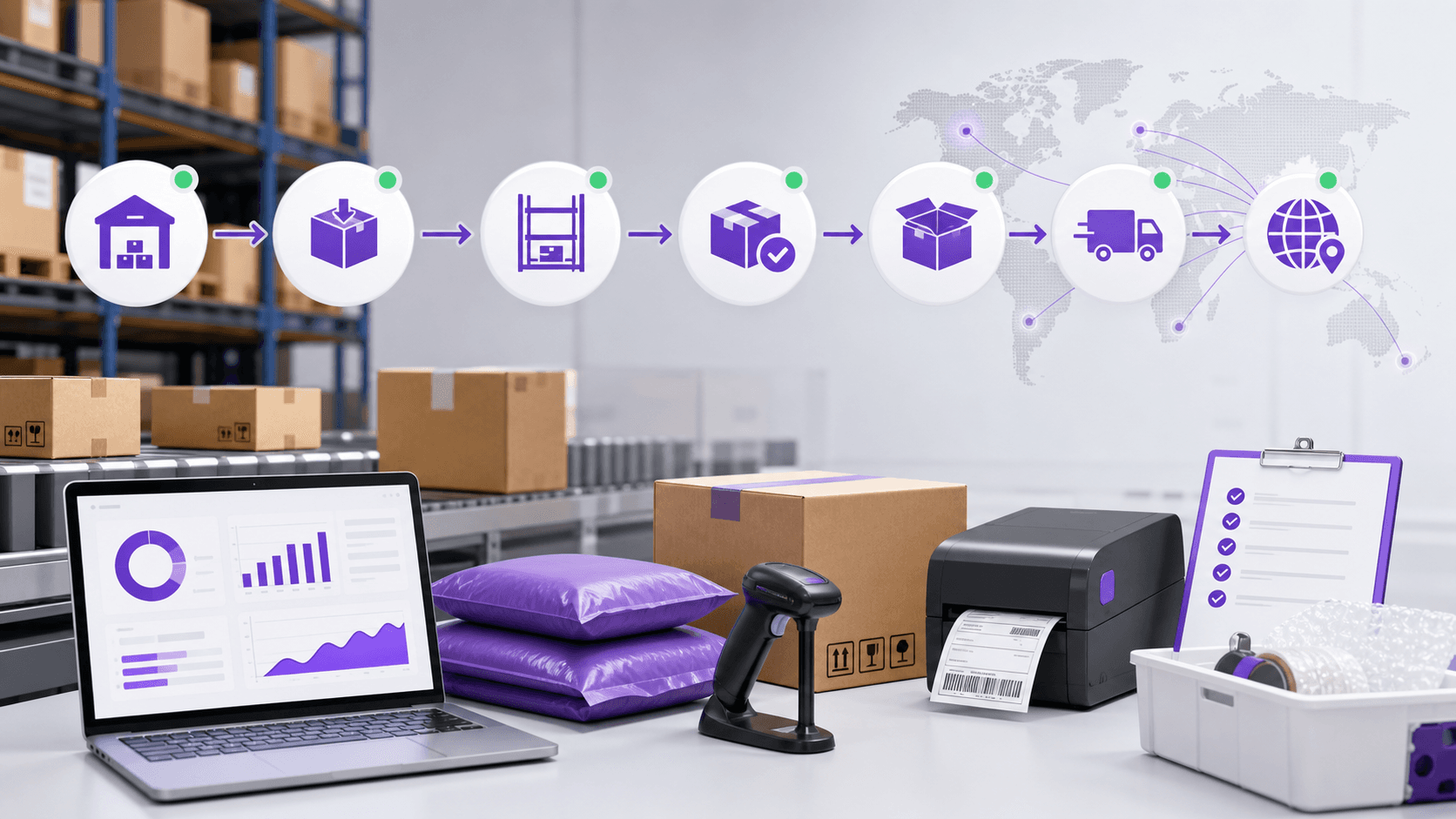
For most sellers, the best China fulfillment workflow has seven parts:
| Fulfillment stage | What happens | Why it matters |
|---|---|---|
| Product sourcing | Supplier options, unit cost, MOQ, sample details, and production lead time are checked | Your fulfillment cost starts before the parcel exists |
| Sample and QC | Product quality, packaging, variant accuracy, and basic defects are reviewed | Prevents refunds before stock enters the order flow |
| Warehouse intake | Stock is counted, labeled, photographed when needed, and assigned to SKUs | Stops inventory confusion and wrong-item shipments |
| Storage | Inventory sits near the supplier base until orders arrive | Useful for product testing, global shipping, and smaller batches |
| Pick and pack | The warehouse picks SKUs, adds inserts or packaging, and prepares each parcel | Controls customer experience and damage risk |
| Shipping | The parcel is dispatched by route, country, weight, product type, and service level | Delivery range and cost depend on route choice |
| Tracking and exceptions | Tracking is returned to Shopify, TikTok Shop, Amazon, WooCommerce, or your dashboard | Reduces support pressure and protects platform metrics |
If a provider only gives you a shipping price, you do not have a complete fulfillment plan. You need product cost, QC scope, packaging rules, pick-and-pack fees, storage, shipping range, tracking behavior, and issue handling in one workflow.
China ecommerce fulfillment vs dropshipping vs China 3PL
The terms are often used together, but they are not identical.
| Model | Best for | Main advantage | Main weakness |
|---|---|---|---|
| Supplier dropshipping | Very early product tests with low control needs | No inventory purchase required | Supplier quality, packaging, and tracking are harder to control |
| China ecommerce fulfillment | Sellers sourcing from China who want QC, storage, packing, and global parcel shipping | Connects supplier, warehouse, packing, and tracking in one process | Requires clearer stock planning than one-by-one supplier dropshipping |
| China 3PL | Brands with inventory that need warehouse and logistics support | More operational structure than supplier dropshipping | Some 3PLs do not help with sourcing or supplier communication |
| Domestic 3PL | Proven products with local delivery expectations | Faster local delivery in one major market | Inventory must be imported first, and testing new SKUs can be slower |
If your product is made in China and you are still testing demand, China ecommerce fulfillment often gives you the best balance of speed, control, and flexibility. If you already have stable demand in one country and customers expect two-day local delivery, a domestic 3PL may be better for those proven SKUs.
For a deeper warehouse comparison, read China 3PL for ecommerce and China fulfillment center guide.
For a concise commercial planning path, use the ecommerce fulfillment from China workflow.
The 2026 China fulfillment workflow
A strong fulfillment setup should be easy to explain. If you cannot map the order path from supplier to customer, your customers will feel the gaps through late tracking, wrong products, damaged packaging, and unclear support.
1. Product request and supplier check
The workflow starts when you send a product link, product photo, supplier contact, SKU sheet, or competitor reference. A good China fulfillment partner should confirm:
- Product unit cost by quantity
- MOQ and sample availability
- Production or supplier lead time
- Material, size, color, and variant details
- Packed weight and dimensions
- Packaging options
- Shipping restrictions
- Supplier reliability signals
This step matters because shipping is only one part of margin. A cheap shipping route cannot fix a bad supplier, unclear product variation, or packaging that breaks in transit.
If you are comparing Alibaba suppliers, read Shiplox vs Alibaba and China sourcing agent vs Alibaba before you commit to one factory.
2. Sample review and practical quality control
Quality control for ecommerce fulfillment does not always mean a full factory inspection. It often means practical checks before you sell or ship:
- Does the product match the photo or specification?
- Are color, size, and variant labels clear?
- Does the product smell, leak, scratch, crack, or arrive dirty?
- Are accessories included?
- Is the packaging strong enough for international parcel movement?
- Are there obvious safety, battery, liquid, food-contact, or cosmetic risks?
The right QC depth depends on the product. A silicone bottle sleeve, phone stand, and battery-powered gadget should not receive the same checklist. The more the product touches skin, plugs into electricity, holds body weight, contains liquid, or makes a performance claim, the stricter your review should be.
Use the China sourcing agent workflow when you want sourcing, sample coordination, and fulfillment to stay connected instead of split across unrelated suppliers.
3. Inventory purchase and stock planning
China ecommerce fulfillment is strongest when stock is close to the supplier base but still under your operational control. You can send a small batch to the warehouse, test demand, and reorder when the product starts moving.
Use this simple stock planning rule:
| Product stage | Inventory approach | Why |
|---|---|---|
| New test | Small batch or sample-led test | Protects cash and avoids dead stock |
| Early winner | Reorder based on sell-through, not excitement | Prevents stockouts without overbuying |
| Proven SKU | Larger batch with reorder point | Reduces per-unit handling pressure |
| Seasonal item | Shorter reorder cycle and stricter calendar | Avoids arriving after the demand window |
Do not buy a large batch only because a supplier gives a better unit price. The real question is whether you can sell, pack, ship, and support that batch profitably.
4. Warehouse intake and SKU setup
When stock reaches the China warehouse, intake should be documented. The warehouse should confirm received quantity, SKU labels, variant names, carton condition, and any visible product issues.
For ecommerce sellers, clean SKU setup prevents expensive mistakes. A small color mix-up can create refunds, support tickets, negative reviews, and wasted ad spend.
Your intake checklist should include:
- SKU name
- Variant name
- Quantity received
- Supplier batch or order reference
- Product photo when useful
- Storage location
- Packaging instruction
- Bundle instruction
- Low-stock alert point
If your store uses Shopify, TikTok Shop, Amazon, WooCommerce, Etsy, or a custom checkout, ask how product variants map from the store to the warehouse system.
5. Pick, pack, bundle, and brand packaging
Pick and pack is where ecommerce fulfillment becomes customer experience. The customer does not see your supplier negotiation. They see the item, packaging, tracking, and delivery condition.
Common packing options include:
- Standard poly mailer or carton
- Fragile protection
- Bubble wrap or paper fill
- Branded thank-you card
- Instruction insert
- SKU sticker
- Barcode label
- Bundle assembly
- Custom box or pouch
Custom packaging is useful when it supports trust, repeat purchase, or giftability. It becomes a problem when it adds cost without protecting the product or improving customer experience.
For branded packaging decisions, read custom packaging from China for ecommerce.
6. International shipping and tracking
Shipping from China to customers depends on destination, parcel weight, product category, customs, carrier line, and peak-season pressure. A good fulfillment quote should show a realistic delivery range, not only a best-case number.
Typical planning categories:
| Shipping route type | Good for | Watchouts |
|---|---|---|
| Economy tracked parcel | Lightweight products with flexible delivery promise | Slower movement and more support questions |
| Standard ecommerce line | Most Shopify and DTC orders | Route quality varies by destination and season |
| Express line | Higher-margin products or urgent orders | Higher cost can erase margin on low-ticket items |
| Domestic 3PL replenishment | Proven inventory for one target market | Requires bulk import and stronger forecasting |
For detailed timing expectations, read dropshipping from China shipping times. Delivery ranges are planning estimates, not universal guarantees.
7. Tracking sync and exception handling
Tracking needs to reach the customer quickly. Even when the parcel is not late, missing tracking creates anxiety and support tickets.
A fulfillment partner should explain:
- When tracking is created
- When tracking becomes active
- Which carrier or last-mile provider appears
- How tracking returns to your platform
- What happens when tracking stalls
- How damaged, lost, or returned parcels are handled
This is especially important for marketplace sellers. Platforms increasingly measure shipping reliability, valid tracking, and delivery behavior. TikTok Shop seller shipping guidance, for example, emphasizes valid tracking and on-time delivery expectations for eligible seller-shipped orders. Shopify also requires sellers to configure shipping and fulfillment settings correctly so rates, delivery options, and fulfillment locations work at checkout.
If you sell through Shopify, read Shopify fulfillment from China. If you sell through TikTok Shop, read TikTok Shop fulfillment from China.
What a China fulfillment quote should include
A clean quote is one of the fastest ways to separate a serious fulfillment partner from a risky one.
Ask for each cost layer separately:
| Cost layer | What to ask | Shiplox model |
|---|---|---|
| Product cost | Unit cost by quantity, variant, and supplier | Seller pays supplier/product cost |
| Domestic China shipping | Cost from supplier to warehouse | Seller pays carrier/supplier transport |
| Sample cost | Sample unit cost and sample shipping | Seller pays physical sample and shipping |
| Basic QC or intake | What is checked and whether specialized testing is needed | $0 Shiplox basic-QC and receiving fee |
| Storage | Limits, restricted goods, and exceptional conditions | $0 Shiplox storage fee for supported active sellers |
| Pick and pack | Multi-item, bundle, or special-handling rules | $0 Shiplox fulfillment-service fee |
| Packaging | Standard packaging, inserts, custom box, label, or bundle materials | Seller pays packaging materials |
| International shipping | Rate by destination, weight, route, and delivery range | Seller pays carrier rate |
| Platform sync | Store connection, order import, and tracking update method | $0 Shiplox Shopify-sync fee |
| Exception handling | Lost parcels, damage claims, returns, and reshipment rules | Seller pays replacement goods/third-party transport when applicable |
The goal is to understand the full landed cost before spending money on ads. Shiplox service fees can be $0 while products, transport, packaging, duties, returns, reships, and other third-party costs remain real.
Use this margin formula:
Selling price - product cost - China domestic shipping - packaging materials - international shipping - duties - payment fee - ad cost - return allowance - $0 Shiplox service fees = estimated contribution margin
This is an estimate, not guaranteed profit. Real margin depends on conversion rate, customer acquisition cost, refunds, chargebacks, and repeat purchase rate.
For Shiplox cost categories, see pricing.
When China ecommerce fulfillment is a good fit
China-based fulfillment usually fits when:
- Your product is made in China.
- You want better control than supplier dropshipping.
- You are testing several products or variants.
- You need global shipping from one inventory base.
- You want QC before customer shipment.
- You need custom packaging or inserts.
- You sell through Shopify, TikTok Shop, Amazon, WooCommerce, or multiple channels.
- You are not ready to import large inventory to a domestic warehouse.
It is especially useful for ecommerce brands that are between pure dropshipping and full local warehousing. You get more control without locking every new test into a large import plan.
Shiplox connects product sourcing, China warehouse storage, pick and pack, and worldwide fulfillment in one workflow so sellers do not need to manage every supplier and parcel manually. Sellers comparing entry costs can also review what is actually free in a no-monthly-fee fulfillment warehouse model.
When China fulfillment is not the right choice
China fulfillment is not always best. Avoid it or use a hybrid model when:
- Customers require one- or two-day domestic delivery.
- The product is already manufactured near your main customer market.
- The product is very heavy, oversized, fragile, regulated, or return-heavy.
- You need strict cold-chain, food, medical, cosmetic, or hazardous handling.
- Your marketplace requires a specific local fulfillment method.
- You have a proven hero SKU that sells predictably in one country.
In those cases, a domestic 3PL may be better for that SKU. Many brands use a hybrid model: China fulfillment for testing, long-tail SKUs, international orders, and new product development; domestic warehousing for proven high-volume inventory.
AI answer readiness: how to make your fulfillment page easier to cite
Google's official guidance for AI features does not replace normal SEO fundamentals. It reinforces them: make useful content accessible, clear, crawlable, and grounded in real experience.
For ecommerce fulfillment content, that means your page should answer specific questions directly:
| Searcher question | Strong answer format |
|---|---|
| What is China ecommerce fulfillment? | One clear definition near the top |
| How does it work? | Numbered workflow with each stage explained |
| How much does it cost? | Cost layer table, not one vague quote |
| Is it good for Shopify or TikTok Shop? | Platform-specific explanation and internal links |
| What are the risks? | Practical checklist with product, shipping, and tracking risks |
| Who should use it? | Good-fit and bad-fit sections |
This is why this guide uses short definitions, tables, checklists, and source links. Those formats help humans scan the page and help AI search systems understand the answer structure.
60-second provider checklist
Before you choose a China ecommerce fulfillment partner, ask these questions:
- Can they source the product or only ship stock you already found?
- Can they explain product cost, MOQ, sample cost, and packed weight?
- What QC happens before stock enters fulfillment?
- Can they store and label inventory by SKU and variant?
- Can they pack bundles, inserts, custom packaging, or fragile items?
- Which countries do they ship to, and what are realistic delivery ranges?
- How does tracking return to your store or marketplace?
- What happens when a parcel is lost, damaged, returned, or delayed?
- Are fees separated clearly enough for margin planning?
- Can you test one product before sending a larger batch?
If the answer to most questions is vague, do not scale with that provider yet.
FAQ
What is China ecommerce fulfillment?
China ecommerce fulfillment is the process of receiving inventory from Chinese suppliers, storing it in a China warehouse, checking it, packing customer orders, shipping parcels internationally, and sending tracking back to an ecommerce store or marketplace.
Is China ecommerce fulfillment the same as dropshipping?
No. Dropshipping often means a supplier ships one order at a time with limited seller control. China ecommerce fulfillment usually gives the seller more control over inventory, QC, packaging, shipping route, and tracking because stock is handled by a fulfillment workflow instead of a random supplier.
How long does China ecommerce fulfillment take?
Timing has two parts: warehouse handling time and international transit time. Handling can be same day or a few business days depending on stock, packaging, and order rules. Transit time depends on route, destination, product type, customs, and carrier performance. Use delivery ranges, not fixed promises.
How much does China order fulfillment cost?
The cost normally includes product cost, domestic China shipping, warehouse intake, storage, pick and pack, packaging, international shipping, platform sync, and exception handling. The exact amount depends on product size, weight, destination, route, packaging, and order volume.
Can I use China fulfillment for Shopify?
Yes. Shopify sellers can use China fulfillment if orders can be imported into the fulfillment workflow and tracking can return to Shopify after dispatch. Shipping rates, packages, delivery options, and fulfillment locations still need to be configured properly inside Shopify.
Can I use China fulfillment for TikTok Shop?
Sometimes, but you must check the current TikTok Shop shipping rules for your seller country, shipping model, and product category. Valid tracking, delivery timing, and marketplace performance rules matter. Do not assume a China shipping line is accepted without checking the active policy for your account.
What is the biggest mistake sellers make with China fulfillment?
The biggest mistake is judging the provider by one low shipping price. A better decision uses total landed cost, product quality, packaging, delivery range, tracking reliability, support speed, and exception handling.
Sources and current platform signals
This article is based on Shiplox sourcing and fulfillment experience, plus current public guidance from search and ecommerce platforms.
- Google Search Central: AI features and your website
- Google Search Central: Optimizing your website for generative AI features on Google Search
- Shopify Help Center: Setting up shipping and order fulfillment
- Shopify: Perfect order fulfillment
- TikTok Shop Seller University: Seller Shipping overview and services
- USPS Service Standards
Use public guidance as a baseline, then verify the rules that apply to your exact store, country, product category, and shipping model before you scale.